IAJE & NEA: A 4-Bar Intro

Each year, the kick-off event to the IAJE conference is a Gala Dinner (black-ie optional). During the affair, the primary purpose of which is to thank the convention sponsors and major IAJE donors, awards are given, and a student ensemble (the Clifford Brown – Stan Getz Fellowship All-Stars) provides musical entertainment. Cocktails were followed by dinner in the Trianon Ballroom. John wore his tux and we were seated at the host table with Nancy Wilson, IAJE President’s Award honoree Clark Terry and his wife, Gwen, NEA Chairman Dana Gioia, and IAJE President David Caffey. Across the room I spotted George Wein and Jesse Jackson, the latter in town to eulogize Lou Rawls.

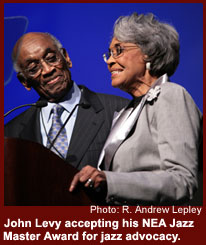
It’s all about seeing and being seen, and it’s often the only opportunity to see folks who are on hand for the convention but who you might not otherwise see because of conflicting schedules. For us, those hellos included composer and band leader Maria Schneider (an amazingly talented young lady who I had the privilege of managing for five years), Doc Severinsen, bassist John Clayton, and pianist Mike Wolff. Nancy introduced all the Jazz Masters past and present, getting predictably emotional when she spoke about John, who has not only been her manager but also the steadiest and most reliable force in her life for nearly fifty years, through ups and downs, births, deaths, and marriages. Two nights later at the NEA Concert and Award Ceremony she would say “John Levy is one of the most special men I have ever known in my life. I want to thank him for being my father. I want to thank him for being the man who made me.”

When Nancy introduced the five high school student all-stars she set the bar high, suggesting that they would have to be really good to hold their own with the Sisters in Jazz Collegiate All-Stars. Perhaps it was an unfair contest to pit high-school against college, but something worth striving for. Sad to say, in my not so humble opinion, this year’s young men were not up to the challenge – they had plenty of technique, but little else. The usual excuse given for such a weak ensemble performance is that the group had little if any opportunity to work together, but I don’t buy it. Jazz is not a solo sport, and it seems to me that young players today are either not taught to listen, or they are not interested in the art of listening – everyone was way too busy showing off their chops.

After a video segment featuring one of his inimitable performances of “Mumbles” – a hilarity that never fails to amuse and delight no matter how many times it’s been heard – Clark Terry walked onstage looking very dapper, right down to his blue patterned shoes. (Perhaps alligator?). He has received so many proclamations, citations, city keys, and hall-of-fame inductions, not to mention multiple honorary doctorates, three Grammy nominations, the French Medal of Honor, and a German knighthood, that the IAJE award might have seemed a small thing, but not to CT. He was truly moved, and so was the audience.

IAJE & NEA: Prelude

I don’t know what made me think that I could see everyone and do everything that I wanted to see and do while in New York City – wishful thinking, I guess. I really wanted to meet Just Muttering in person and I also hoped to stop by Local 802 to visit bassist Bill Crow. Both were high on my list of personal priorities, and they are now at the very top of the list for my March trip. I did manage to fit in two personal appointments — lunch alone with my parents, and lunch with my best girlfriend of 45+ years — after that, it was pretty much all business on multiple fronts.

John and I arrived in the Big Apple uneventfully on Sunday, early evening. After unpacking, we set out to find some dinner. On Seventh Avenue, between 54th and 55th Streets, a door or two south of the Carnegie Deli, is China Regency. This inexpensive Chinese restaurant has been there for more years than I can remember, and it was always a favorite of Joe Williams. John and I shared an order of shrimp in lobster sauce with fried rice, and that hit the spot.

My cell phone began ringing at 8 AM on Monday morning – still 5 AM to mind and body. It was Pam Koslow, producer of Jelly’s Last Jam and widow of the show’s Broadway star, Gregory Hines. “I can meet you tomorrow at 10 AM, she said, and so began my rescheduling. The Luther Henderson biography interviews that I had intended to do on Monday and Tuesday, before the convention began, got moved to Tuesday, Wednesday, and Thursday.

After meetings with the IAJE (International Association for Jazz Education) and NEA (National Endowment for the Arts) staff people to finalize details of John’s schedule, John and I were off to have tea with George and Ellie Shearing. Over a tasty fruit tart and cups of brewed tea, John and George reminisced. George’s short-term memory is not as vivid as his recollections of the past, but he still takes great delight in re-telling the stories of the original quintet and his escapades with John that began in 1949 and continued for any years. The road stories are always the best, including George, behind the wheel, driving across the desert in Nevada. Ellie told us that she and George attended a concert at the 92nd Street Y the week before, where Dick Hyman, Bill Charlap and others played several of George’s compositions. She also told us that George has been playing duets at home with Michael Feinstein and other musical cohorts who come to visit.

Tuesday morning I met with Pam Koslow who talked me through the trials and tribulations of producing a show for Broadway. The trip from idea inception to stage realization took ten years, but it was worth every nerve-pinching moment, even when she and co-producer Margo Lion had to put their apartments up for loan collateral. After checking in with John, I took off for downtown to have a late lunch with my parents while John prepped for his 4 pm interview with Sara Fishko of WNYC radio. (To listen, click here.)

By 6 pm we were ordering cocktails at Fontana Di Trevi, our favorite mid-town Italian restaurant, with long-time friend Laurie Goldstein who also happens to be the exec in charge of GOPAM, the music publishing company that John set up several decades ago to administer music publishing for his clients. This is one of John’s claims to fame, as it were. He believed that jazz musicians ought not to give away their publishing rights, so he set up individual publishing companies wholly owned by each artist/composer. We lingered over cappuccinos and by the time we returned to the hotel, Clairdee and Ken had just arrived from the airport and were checking in. We ended the night with them at the hotel bar.

At 9 o’clock on Wednesday morning I was knocking on Chico Hamilton’s door. Chico was the drummer with Lena Horne during the days when Luther Henderson was her musical director. For almost two hours Chico told me stories dating back to 1947 when Luther first hired him. He described the rehearsal scene at the house on Nichols Canyon Road where Lena and Lennie Hayton lived – the big gate and Luther, the “sharp dude” who came out in answer to the bell. He talked about rehearsing bar by bar, touring by train (Lena didn’t fly), and earning $125 week out of which he had to pay his own room and board.

As I was leaving Chico’s studio and walking over to Third Avenue, I returned a call to Duane Grant. Duane was not only Luther’s step-son, but also his musical assistant for many years and I wanted very much to spend some quality time talking to him. It was with Duane’s help that Luther was able to complete one of the most important events in Luther’s life, the Classic Ellington project. Luck was with me and we made a date to meet for two hours the next morning. As I headed uptown to the Candle Café to meet my girlfriend for lunch, John was live on WBGO radio with Rhonda Hamilton. (You can hear an excerpt here.)

John and I rendezvoused back at the hotel in time to suit up – both of us in tux – for the Gala kick-off dinner hosted for IAJE by none other than Miss Nancy Wilson.

Did You Miss Me?

For some reason that I cannot yet fathom, all of my laptop’s network connections have failed on me — the wired Ethernet jack, the wireless PCMCIA card and the wired PCMCIA — so I have been unable to get online to blog from New York. We’re still here in the Big Apple, flying home tomorrow, and I’m posting a quick note to you from Studio D in the Sony Recording Studios on West 54th Street in New York. It’s been a whirlwind week plus here, all very exciting and exhilarating. After a busy week of John doing interviews, signing autographs and becoming a National Endowment for the Arts Jazz Master (along with Ray Baretto, Tony Bennett, Bob Brookmeyer, Chick Corea, Buddy DeFranco, and Freddie Hubbard), we spent yesterday and today with Nancy Wilson and our friends from MCG Jazz as they finish up Nancy’s new recording. The CD, which will be titled Turn To Blue, features a number of guest soloists and today there are four Jazz Masters in the room at one time: Nancy, Jimmy Heath, Dr. Billy Taylor, and John (no, John is not playing). Regina Carter, who is down the hall mixing her latest recording, stopped by just in time for a sip of celebratory champagne. Looks like a wrap. I’ll be back online no later than Wednesday with a full report of our trip.

Today, Yesterday, or Tomorrow?

I’m all for living in the moment, enjoying, savoring and fully experiencing the now. Such intense focus, however, doesn’t leave much time or energy for remembering the past. So what? Some may say that time spent reminscing is time wasted, but we are the sum of our experiences and they ought not to be forgotten. Often in the remembering, or re-remembering, experiences that occured between then and now shed new light and we may gain new perspectives, make new discoveries that will inform our lives today and tomorrow. My goal is to remember and learn from yesterday, live for today, and hope for tomorrow.

Serendipitous with this thought, I just discovered a new online literary publication. Each month LOST publishes nonfiction and fiction pieces about lost people, places and things, tangible and intangible. In their own words, here is “What LOST Strives To Do:”

“As we go through our daily lives, we live largely in the now and in the future. But we stand on a past that still surrounds us in the form of whispers: whispers of old buildings, old objects, old lives. Whispers that, every day, go lost.

“LOST Magazine is all about reclaiming those things that the world has passed by, that may or may not still be whispering around us.

“Many topics on which LOST seeks to publish are bittersweet; all are worth remembering, and many are worth celebrating. LOST is a magazine for people who think about lost landscapes, lost albums, lost letters, lost loves, lost elections, lost cultures, lost faith, and lost time. LOST is a magazine for readers who care for how much life exists in what’s left and left behind.”

To which I’d like to add the words of Charlie Parker: “If you don’t live it, it won’t come out of your horn.”

On The Air

John Levy was on Tavis Smiley’s radio program this week. Tavis Talks is aired via PRI (public radio) in different cities on various stations at various times. The interviews are also posted on the web, but I do not know how long they remain there. Click here to go to Tavis Talks and then click on The Tavis Smiley Show From PRI to see the interviews — click on one to listen.

And while we’re talking radio, this just in from my friend Bill Kirchner:

Recently, I taped my next one-hour show for the “Jazz From the Archives” series. Presented by the Institute of Jazz Studies, the series runs every Sunday on WBGO-FM (88.3).

Sometime in the mid-1950s, a young woman from Detroit named Sara Cassey (1929-1966) moved to New York City. For a few years in the late ’50s and early ’60s, while she worked for Riverside Records, her beautifully-crafted pieces (calling them “tunes” doesn’t do them justice) were recorded by Clark Terry (with Thelonious Monk), Hank and Elvin Jones, Billy Taylor, Junior Mance, Johnny Griffin (with Barry Harris), Stan Kenton (with singer Jean Turner), and
others. Cassey committed suicide at age 37, and she has been virtually forgotten. But her music still sounds fresh and original, as recordings by the aforementioned artists and others demonstrate.

The show will air this Sunday, January 8, from 11 p.m. to midnight, Eastern Standard Time.

NOTE: If you live outside the New York City metropolitan area, WBGO also broadcasts on the Internet at www.wbgo.org.

Mourning

Wednesday I wanted to scream out right away, to condemn the media for its ineptitude, but I thought I’d best wait a bit, think a little, and see how the facts played out; would that the journalists employed by major media have done the same. In the rush to best the competition, be first on the scene and lead with the latest breaking news, broadcasters magnified the mining debacle by bringing it to us as it was happening without ever checking the facts. This is nothing new – almost daily you can hear me talking back to my television, berating some twit of a reporter, more often an anchor person, for asking the dumbest questions about events when it is clear to any moron that the answers are unknown as yet. Then, to make matters worse, because there are no answers, the talking heads speculate, project, and guess. Of course those who say “I heard it on the news, it must be true” should shoulder some blame, but only a little. I guess the days of fact-checking and requiring corroborating sources are long gone. I mourn for that as well as for the miners who lost their lives to bring us coal, possibly under unsafe conditions that could have been prevented. When are we going to learn that caring for people is more important than money or ratings?

Back In The Box

It’s time to pack up The Christmas Box again, the small fake tree, strings of indoor lights, ceramic ornaments made by a friend, the snowman candle holder. At the top of the box will be the Christmas music – six CDs and three old cassettes that I play pretty incessantly during the month of December, after which I am glad not to hear them again for another year. They’re all great, but the first one on the list is my all-time favorite…talk about swinging! They are:

    Christmas Cookin’ — Jimmy Smith (Verve)
    The Christmas Song — Nat King Cole (Capitol)
    A Jazz Piano Christmas — 17 fabulous pianists including Tommy Flanagan, John Lewis, and Junior Mance (NPR Classics)
    Christmas with Etta Jones (Muse)
    A Nancy Wilson Christmas (MCG Jazz)
    Guitars for Christmas — Joe Negri (MCG Jazz)
    The Three Tenors Christmas — Carreras, Domingo and Pavorotti (Sony Classical)
    Christmas Classics for Guitar – Steven Pasero (Sugo)
    Christmas Island — Leon Redbone (Private Music)

The poinsettias get to stay in the house, but we’ll have to see how long last as I do not have the greenest thumb where potted plants are concerned. We didn’t hang the icicle lights from the roof this year, so they’re still in the box. Outside, the light-up snowman family and a few light blankets (not strings) must also return to the garage where all will hibernate until next year.

Biographies

In his autobiography, All The Strange Hours: The Excavation of a Life” Loren Eiseley wrote:

“A biography is always constructed from ruins, but, as any archeologist will tell you, there is never the means to unearth all the rooms, or follow the buried roads, or dig into every cistern for treasure. You try to see what the ruin meant to whoever inhabited it and, if you are lucky, you see a little way backward into time.”

I am currently in the process of reconstructing the scaffolding of Luther Henderson’s life, trying to discover which were the turning points and pivotal moments, what were the experiences that shaped him, and which were those by which he left his imprint on history.

Biographical writing can range from the finely crafted literary profiles such as those published in The New Yorker magazine (Whitney Balliett’s being among my favorites), to short books (a fine and highly recommended example being All In The Dances: A Brief Life of George Balanchine by Terry Teachout), to lengthy books heavy with annotations and citations (Laurence Bergreen’s works come to mind), to multi-volume oeuvres (such as Edmund Morris’s projected three-volume life of Theodore Roosevelt), or even the artful collaboration of biography with photography in a coffee-table sized tome (Take Five: The Public and Private Lives of Paul Desmond by Doug Ramsey, also highly recommended, of course – I’m on page 264).

Assuming one is not writing the definitive and most comprehensive account that would necessitate including everything one took, say, ten-plus years to find, one must choose the best approach for the subject and select just the right moments to suit the plan. Take the above-mentioned Balanchine bio, for example. Teachout says up front:

“This is a short book about a great man who lived a long life. It is not a full-scale biography and makes no pretense of thoroughness or originality….”

He goes on to explain who his intended reader is:

“I had in mind a reader who has just seen his first ballet by Balanchine, or is about to do so, and wants to know something about Balanchine’s life and work and how they fit into the larger story of art in the twentieth century.”

He then chose the personal and performance events that best told the story for his audience with his goals in mind. One must take care to include enough so that the portrait is “true” and not lopsided, but I am not prone to embrace the mega biography a là Bergreen who writes long and uses a chronological, annotated format as seen in Louis Armstrong: An Extravagant Life, As Thousands Cheer: The Life of Irving Berlin, James Agee: A Life, and Capone: The Man and the Era. As I wrote in 1997 for a “Brief” review of the Armstrong bio for The New York Times Book Review section:

The exhaustive research that characterizes Mr. Bergreen’s work does, however, have its occasional downside. The thread of Mr. Armstrong’s story gets lost from time to time amid the lengthy excursions into the history of New Orleans and voodoo beliefs, the geographical evolution of jazz, the Harlem renaissance of the mis-1920s, and the mini profiles of the many people who populated his life. While these portraits are vivid, pages go by in which Mr. Armstrong plays no part whatsoever. Furthermore, readers might wonder whether the fact that Mr. Bergreen is not a member of the musical scene was of help or hindrance in interpreting his findings, and to what extent the biases and experiences of his sources may have colored what he learned.

(Note of Admission: That review was accepted and paid for, but was pulled when my editor discovered that another editor had commissioned a full feature-length review by another writer, one of greater stature to be sure. That writer later become a dear friend….it was none other than Terry Teachout. Anyway, I digress.)

One of the IAJE panels next week is about biographies. Titled “Jazz Lives in Print,” the blurb reads:

The last decade has seen a torrent of new jazz biographies, some comprehensive and thorough, others mere hearsay and hagiography. What makes a good jazz biography? What are readers, fans and musicians looking for in a good bio? Personal anecdotes? Musical analysis? Social Context? A little of all three? Four prominent authors of recent jazz biographies discuss how they did their research and made their decisions about what to include (and not to include). Moderator: Paul de Barros, Seattle Times. Panelists: Gary Giddins, JazzTimes; Ashley Kahn, Wall Street Journal; Peter Levinson, Peter Levinson Communications; Stephanie Stein Crease.

De Barros (Jackson Street After Hours: The Roots of Jazz in Seattle) and Levinson (bios on Tommy Dorsey, Nelson Riddle, and Harry James) are friends of mine, Giddins (Bing Crosby: A Pocketful of Dreams) a longtime acquaintance, so I hope to attend. I sure can use their input!

Vocal Legacy

The press release headline reads: New Concert Package Developed By Legendary Talent Manager John Levy Debuts At World’s Largest Jazz Conference On January 14th In NYC

You already know that John is among those being honored as an NEA Jazz Master, but what you may not know is that John is not exactly partial to the spotlight. There’s no “aw, shucks” about it; he’s really only interested in what he can do to promotes his clients, and he truly enjoys using his talents to help others achieve their artistic goals. Don’t get me wrong, it’s not that he doesn’t appreciate the honor, he is quite pleased about it, but he says he didn’t do it alone, he had a lot of help along the way, and he’s just more comfortable behind the scenes. And make no mistake, he will be working behind those scenes at IAJE next week promoting Vocal Legacy.

Featuring Clairdee’s song stylings and Henry Johnson’s mellow tones on guitar and vocals, Vocal Legacy will make its debut at IAJE on Saturday, January 14th at 6:00 p.m. in the Sutton South room at the Hilton Hotel. The Legacy Ensemble, under the direction of pianist Ken French, includes bassist Mary Ann McSweeney and drummer Dennis Mackrel.

According to John, the concept was simple…

“Vocal Legacy is a new twist on the classic jazz standard. Clairdee is a new client, Henry been on my roster for a while. I thought, why not let the two collaborate and create something fresh and new, but familiar. We could give audiences that clamor for the real taste of jazz an engaging performance, without the heavy price tag. I’m offering traditional jazz vocals by younger artists, with a contemporary edgy style to prove that those days of great music are not gone. Their appeal is straightforward, it is an easy to follow recipe for success… a dash of this, a pitch of that! Clairdee own unique sound is a contemporary blend influenced by the sassy irreverence of Carmen McRae, the silky soulfulness of Natalie Cole, and Shirley Horn’s understated approach. If you liked the complex melody of Joe Williams, the soulfulness of Lou Rawls and Bill Withers, you’ll enjoy hearing the voice of Henry Johnson.”

And it’s all about the legacy.

“I titled the group Vocal Legacy because what I envisioned was a legacy of the classic jazz vocal genre. I am passionate about preserving the musical heritage as well as nurturing the continued growth of the art form. Jazz is timeless and the lyrics of the jazz standards still ring true.”

After more than five decades as a manager of the top names in jazz, this is John’s legacy too.

Henry Johnson and Clairdee share the same passion for the music’s melody and lyrics. Their performance on the 14th will present a contemporary twist while still maintaining the tradition of the great jazz vocalists before them. The selection of songs for the show was inspired by the great artists who came before them, and while no attempt is made to evoke the styles of their predecessors, Vocal Legacy is a tribute to them and the legacy they left. The performance will include:

The Great City (Salute to Shirley Horn)
Sunday In New York (Salute to Shirley Horn)
Do Something (Salute to Betty Carter)
After You’ve Gone (Salute to Joe Williams)
My One & Only Love/Why Did I Choose You (Salute to Johnny Hartman)
Summertime (Salute to Donny Hathaway)
All They Way (Salute to Frank Sinatra)
Deed I Do (Salute to Helen Humes)
Someone Else Is Steppin’ In (Salute to Ernestine Anderson)
For All We Know (Salute to Nat Cole)
Alright, Okay, You Win (Salute to Joe Williams)

Johnson, whose musical roots run deep into gospel, blues, and jazz, toured extensively with the groups of pianist Ramsey Lewis and legendary jazz vocalist Joe Williams before forming his own group, Organ Express. Johnson’s style is a testament to the influences of Kenny Burrell, George Benson, and most significantly, Wes Montgomery. Henry’s seven albums as a leader include Organic with special guest Nancy Wilson (A440 Records), An Evening At Sea (Chiaroscuro Records), and others on the MCA/Impulse and Heads Up labels.

Clairdee, a longtime member of the International Association for Jazz Education, is also an Artist-In-Residence with the San Francisco Symphony’s “Adventures in Music” series, the vocal instructor for University of California Berkeley Jazz Department, and teaches “Jazz & Popular Solo Voice” at Diablo Valley College. Her new CD, Music Moves (Declare Music/Hyena Records), is chartbound; earlier recordings on the Declare Music label include This Christmas and Destination Moon.

Ken French, director of the Legacy Ensemble, is musical director, arranger and pianist who has worked with Clairdee since 1998. With solid early training in classical piano, French discovered his passion for jazz in a high school music program in Seattle, Washington. While studying music composition, piano and philosophy at the University of Puget Sound, he demonstrated an affinity for exploring new perspectives with the classic standards. A performing professional for two decades, he cites influences as diverse as Miles Davis, André Previn, and Stevie Wonder. French is a sought after educator who enjoys conducting clinics and master classes in jazz improvisation, accompaniment, arranging, composition and related topics.

Bassist McSweeney, recently back from touring with Lee Konitz, has also performed with Dizzy Gillespie, Jimmy Witherspoon, Betty O’Hara, Stacy Rowles, Rick Margitza, Lynn Ariel, Maiden Voyage Big Band, and the Ed Palermo Big Band to name a few. She has recorded with the Jim Cifelli New York Nonet, the Diva Big Band, Gene Burkert, Nana Simopoulos and Manhattan Vocal Project among others. On the classical side, she has worked with conductors Leonard Bernstein, John Williams and Lalo Schifrin.

Drummer Dennis Mackrel is a seasoned musician and clinician, traveling extensively and performing with such ensembles as The Carla Bley Very Large Band, Slide Hampton and the Jazz Masters, The Dizzy Gillespie Alumni Band, The Manhattan Symphony Jazz Orchestra, The Carnegie Hall Classic Jazz Orchestra, The Hank Jones Trio, The Maria Schneider Jazz Orchestra, The Smithsonian Jazz Orchestra, and The American Jazz Orchestra. His compositions and arrangements have been recorded and performed internationally, and some of the other notable musicians Dennis has performed with include: Monty Alexander, John Pizzarelli, Harry Connick Jr., Lionel Hampton, Tony Bennett, Joe Williams, Nancy Wilson, and Quincy Jones.