Jazz in China?

JazzPortraits blogger Joe Moore (who is also Station Manager of KFSR FM in Fresno, California) asks Jazz in China? to which I reply with the first paragraph from William Zinsser’s “Mitchell & Ruff: An American Profile in Jazz

“Jazz came to China for the first time on the afternoon of June 2, 1981, when the American bassist and French-horn player Willie Ruff introduced himself and his partner, the pianist Dwike Mitchell, to several hundred students and profesors who were crowded into a large room at the Shanghai Conservatory of Music.The students and the professors were all expectant, without knowing quite what to expect. They only knew that they were about to hear the first American jazz concert ever presented to the Chinese. Probably they were not surprised to find that the two musicians were black, though black Americans are a rarity in the People’s Republic. What they undoubtedly didn’t expect was that Ruff would talk to them in Chinese, and when he began they mummered with delight.”

Originally published in 1984, with a foreword by Alfred Murray, this once-out-of-print book has been reissued in paperback by Paul Dry Books. (They also re-issued Boston Boy by Nat Hentoff.)

Ruff’s web site includes a page about the duo and I was also happy to find a CD, Breaking the Silence – Standards, Strayhorn & Lullabies, newly issued in celebration of the re-issued book. Also of great interest is Jerry Jazz Musician’s interview with Zinsser about “his special friendship with Mitchell and Ruff, their background, and the incredible journeys he accompanied them on throughout the world.”
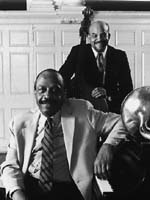
Note: Photo credit for the picture belongs to Reginald Jackson.

Subliminal Career Goals?

In today’s The New York Times, an Arts section headline caught my eye: “Pentagon’s New Goal: Put Science Into Scripts” Twenty-five thousand dollars in Pentagon research grants is paying for the scriptwriting education of a group of mid-career researchers, engineers, chemists and physicists.

“Fewer and fewer students are pursuing science and engineering. While immigrants are taking up the slack in many areas, defense laboratories and industries generally require American citizenship or permanent residency. So a crisis is looming, unless careers in science and engineering suddenly become hugely popular, said Robert J. Barker, an Air Force program manager who approved the grant. And what better way to get a lot of young people interested in science than by producing movies and television shows that depict scientists in flattering ways?”

My first three thoughts were:

1. If it works for science, maybe it will work for jazz and classical music — or maybe not. Fabulous movie music is usually that which achieves its goals without the audience taking notice. It serves to heighten the story, and story is what movies are all about. Stories thrive on conflict and obstacles. Movies that showcase jazz (“‘Round Midnight” and “Bird”) tend to highlight those whose drug-filled lives provide the requisite tension and contrast to the beauty of the music. Movies that showcase classical music (say Roman Polanski’s “The Pianist” or “Amadeus” directed by Milos Forman) appeal to a more mature audience, one that is already in the choir.

2. It could backfire: I like to watch CSI, but I have no interest in becoming a forensic scientist. With three shows on each week, I’ve become so familiar with luminal and the evolution of maggots that the job has no more and no less allure than that of lawyer or doctor.

3. They want to grab the kids, so they’ll probably focus on laser swords and explosives rather than medicines and fuel efficiency. If we want scientists and musicians to be cool, then we’ve got to reshape our values, instill more inclusive social ideals in our youth to negate the me, myself and I mentality, and better appreciate those whose work brings rewards other than monetary gain, rewards that may be aesthetic, intangible, and/or immeasurable.

What do you think? Send me an email (without the spaces): devra @ devra do write . com

Whiplash

Sorry I’m late with today’s post; whiplash is my excuse. I wish I was referring to Snidely Whiplash, nemesis of Dudley Do-Right, or even just a metaphorical pain in the neck, but alas, I had the misfortune to be in an automobile accident last Friday and headaches are slowing down my productivity. Cruising down New York Drive on my way home from Radio Shack where I had been looking at gizmos for recording telephone interviews, I came upon an obstacle; a large flatbed truck making a delivery was jutting out into the right lane. It was at the bottom of a short steep hill, so one would not see them from off in the distance, and even close upon it the cars in front of me blocked it from clear view. One or more cars must have veered around the truck, but the Altima directly in front of me came to an abrupt stop. The speed limit for that stretch is 50 mph, and I’m not a slow driver, but I do keep a fair distance behind other cars – something like a car length for every 10mph – and so I was able to stop safely, albeit suddenly, without hitting it. Unfortunately, the Ford behind must have been on my tail because he hit me full force; my rear windshield shattered on impact, the trunk of my car crumpled, and I became the gazillionth person to suffer whiplash, also known as acceleration flexion-extension neck injury, soft tissue cervical hyperextension injury, cervical sprain, cervical strain, or hyperextension injury.

When I got home (amazingly, my car was drivable), my husband thought I should go to the hospital to get checked out, so I phoned my doctor, hoping he’d say “take two and call me in the morning.” He didn’t, and off we went to the ER at 7:30 on a Friday evening. I have heard that at an ER, Friday and Saturday nights are second only to Halloween and full moons; I think it must be true. “There are 34 people in front of you,” the receptionist told me. “It will be about three hours.” They’ve got a pretty good system, but unless you’re bleeding out, it does take forever. First you register and they give you a bracelet. Then you wait. Then comes triage — a nurse makes some notes and you go “back to chairs” to wait some more. Then they took me to the x-ray waiting room, and after snapping four films…”back to chairs.” It was after 11 PM when the receptionist took us down a long hallway into another wing where there were more examining rooms. A really pretty nurse came in to say the doc would be in shortly. I thought that pretty nurses and gorgeous doctors existed only on TV, but I was wrong — the doc was quite handsome. He sent me home with powerful pain killing drugs, a soft cervical collar that he told me use nonstop for the first several days and intermittently after that, and a warning that I was going to hurt, a lot, for more than a few days. “Heat will help a little,” he said, “and I don’t see any fractures on the films. Check in with your doctor on Monday.”

Monday I called my doctor, Tuesday I had a CT scan to check for intracranial bleeding, and today I got around to checking the internet for information. What did I learn, besides the fancy names for whiplash mentioned above? The American Academy of Orthopaedic Surgeons website confirms that symptoms may take several months to resolve, and eMedicine.com, boasting “the largest and most current Clinical Knowledge Base available to physicians and other healthcare professionals” concurs: “Most people recover completely from a whiplash injury in the first 12 weeks. Others’ symptoms continue to improve over the course of a year. You have a 40% chance of experiencing some symptoms after 3 months, and an 18% chance after 2 years.”

Whiplash or not, I’ve got to crack my own whip and get into gear…there’s research to be sorted, interviews to be conducted, and blogs to write before I sleep. Well, maybe a little nap….

A Prescription

Seems I am not alone in mourning the loss of unique places. A week after my Village Memories, Terry Teachout was home in Smalltown USA and wrote “I sometimes wonder whether the rural Missouri town where I grew up is losing its individuality.” (read the whole piece here .) Killin’ Time Being Lazy responded with Death of Smalltown USA which also linked to a January piece that quoted this recipe:

RECIPE FOR AN AMERICAN RENAISSANCE:
— Eat In Diners
— Ride Trains
— Put a Porch on Your House
— Shop on Main Street
— Live in a Walkable Community
(“Recipe For An American Renaissance” by Randy Garbin, publisher of Roadside Magazine, Worcester, Massachusetts)

Call it a recipe or a prescription, it sounds like good advice to me. The closest thing to a diner near me is a local establishment called Fox’s where I eat breakfast 2-4 times week. As I think about it, the place is worthy of a blog entry all its own, so I hold off on further description for now. I can’t afford any house renovations at the moment, but my immediate neighbors do tend to congregate out front, and we are not adverse to standing around or siting on the curb. The closest I can get to shopping on Main Street is the stretch of little shops in Sierra Madre that includes a few gifteries, an old fashioned cobbler/shoe repair (albeit folded into the local cleaners), a jewelry store, and tea shop. Millie’s Dancewear, much missed, used to be there too. I admit that I prefer living on a strictly residential street and that popping down to the corner for a quart of milk has lost its allure, still I support the small shops wherever I can find them. As for the trains, well, I ride the Metro North trains in New York, and like the Metroliner between Boston-NY-DC, but out here in Lalaland, mass transit is difficult at best. Still, the Gold Line is now nearby and the next time I have to go to downtown Los Angeles — an infrequent need, but perhaps jury duty next year — I will take a ride.

Django

When in pain – physical or mental – the two things I think most soothing are music (specifics vary by person and will be addressed in a later post) and the unconditional love of a pet. When I was fighting the cancer war, ensconsed at Glendale Adventist Hospital, they had a visiting pet program. I remember one morning, when in one of my darker moods, two strangers walked into my room with two small dogs. I was not in the mood to talk with friends, let alone strangers, but they said that was okay and asked if I wanted to pet the dogs. The dogs were already on my bed and snuggling up — irresistable. The couple carried on their own conversation between themselves and left me to the dogs. I don’t know how long they stayed, it may have been only fifteen minutes, but the effect was long lasting and far outweighed the ocassional unrequested drop-ins from various clerics.

I had a dog when I was very young, a poodle name Bosco. He was a nervous fellow, not meant for city life — or maybe he didn’t like wearing a bonnet and riding in a doll’s carriage — and he soon went to live with someone else in the suburbs. After that we had a succession of cats. So it may have been that hospital visit that primed me for my meeting Django, or maybe it was just fate. It was only a couple of months after the chemo and radiation treatments, and, in anticipation of further medical treatment, I had moved to New York City to be near to my family. One afternoon the apartment buzzer rang and the building superintendent said he had a package for me. I went downstairs and saw a puppy playing in the lobby. It was a cute little black and white ball of fluff, and when I sat down on the floor he jumped right into my lap. (I later learned that this fluffball was a pure-bred Shih-Tzu.) After a few minutes, I asked the super where was my package, and he pointed to the dog. Turns out, some idiot in a building down the block was going to take this dog to the pound, and that building’s superintendent mentioned it to our super who said he’d find a home for the dog. I was told his name was Sluggo, which I promptly changed to Django.

When I moved back to California, my parents agreed to dog sit while John and I got settled in the new house. That was seven years ago, and Django is still living with my parents — the three of them are inseparable. You may have seen Django with Dad on the pages of Jazz Times, or on his web site (Django is in picture #11 of the First Meeting collection here) , or in this shot I copied from a Japanese magazine. Django never strays too far from Mom, either, but she’s not partial to being photographed. The picture at the top is one I took just two weeks ago.

Al McKibbon: May He Rest In Peace

Alfred McKibbon, born January 1st, 1919 at 12:00am in Chicago, Illinois, died this morning at Good Samaratin Hospital in Los Angeles. It seems like just weeks ago that Al and his daughter, Alison, were here at the house — we ended up going out for seafood dinner, Al loved seafood — but that was five months ago. My husband, John, and Al were friends for more than fifty years. When John put down his bass to become a fulltime manager, it was Al that he hired to play bass with the George Shearing Quintet. We will miss him.

Al’s first-person bio, which includes photographs from his personal collection, can be read online here. Also included are liner notes and audio clips from Tumbao Para Los Congueros Di Mi Vida, his first recording as a leader.

And here’s a Wikipedia entry that has links to info about many of the great artist with whom Al worked.

Also check out “Al McKibbon: a living history of Jazz/Al McKibbon and the Roots of Latin Jazz” a recent (April 2005) article by Nelson Rodriguez in Latin Beat Magazine.

Life & Death: Hank Jones, Kenny Burrell, and Luther Henderson

On Sunday, July 31st, pianist Hank Jones will celebrate his 87th birthday, just shy of one year for each key on the piano. Hank was born in Vicksburg, MS on July, 31, 1918, and NPR’s Jazz Profiles, hosted by Nancy Wilson, is celebrating. Check the NPR web site to see when the program airs near you and check out the audio clips of pianists Sir Roland Hanna and Billy Taylor talking about Jones’ personal approach to the piano, and Hank’s own reminiscences of listening to Fats Waller on the radio, watching Art Tatum practice, working on The Ed Sullivan Show, and constantly striving for excellence.
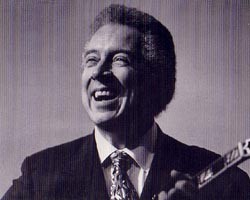
Last month Bookish Gardener heard Hank Jones on a different NPR program (Terry Gross’ Fresh Air – archived here) and wrote:

Disciplined and devout in how he lives, thoughtful and inventive in how he plays—Hank Jones is simply inspiring.

July 31st is also guitarist Kenny Burrell’s birthday — born in Detroit, MI in 1931, he will be 74. A prolific recording artist and composer, Kenny is also the Director of the Jazz Studies Program at UCLA Department of Ethnomusicology His UCLA faculty bio is here and the bio on the Verve Music Group web site is here.

Coincidently, both Hank and Kenny are on my Luther Henderson interview list. Kenny and Luther shared a love of all things Ellington. Hank and Luther both loved Fats Waller, and it was Hank who replaced Luther as the on-stage pianist for Ain’t Misbehavin’ on Broadway. Tomorrow, July 29th, is the second anniversary of Luther’s death.

Bea Arthur & Billy Goldenberg

I was working today on the list of people that I hope to interview for the Luther Henderson biography. It’s a diverse group of folks that includes singers and musicians, actors and actresses, choreographers and conductors, composers and arrangers, producers and directors, not to mention family, friends, and business associates. The variety among the females singers, alone — Barbra Streisand, Ruth Brown, Bea Arthur, Polly Bergan, Lena Horne, and Jessye Norman, to name just a few — attests to the ecclecticism and wide range of Luther’s talents.
Of the six ladies mentioned, I’ve met three: Ruth Brown is a friend, Lena Horne I encountered years ago during my days as a talent coordinator, and Bea Arthur attended the West Coast memorial for Luther in June of 2004. Last month I posted a description of the Canadian Brass’ appearance at the memorial. Here, then, is the excerpt about Bea Arthur and composer Billy Goldenberg:

Bea Arthur, accompanied by Billy Goldenberg, was on hand that Sunday to share some memories. As Billy got settled at the piano, Bea told us a story about her invitation to sing a song called It Amazes Me at an affair honoring Cy Coleman twenty-five years ago.

“I thought, ‘I know there’s going to be a lot of terrific talent honoring Cy,’ and I decided that rather than just slide in and go to rehearsal next day, I thought, ‘No. I’m going to go a day earlier and work with Luther and really kill the people.”

We had no idea how the story would end, but already we were laughing.

“So I did, and we worked; we worked all that day. Quite wonderful. And then the night of the event, which was, I remember, at Peacock Alley at the Waldorf – black tie, oh, I mean it was fabulous – a number of people got up and performed Cy’s stuff. And then Tony Bennett came and started singing and, of course, he leveled the place, just tore the place up to such a degree that – I don’t know if you remember this, Billy – that he had to do an encore. So Cy sat down at the piano and Tony sang…It Amazes Me. I never in my life … I was so devastated! So after that, we just went to the bar and got loaded.”

We, too, were ready to go to the bar and get loaded, but we quieted down as Bea, casually dressed in white pants, tunic top, and sandals, regal as ever, began to sing. Even without a microphone, her voice was strong and sure, her delivery, striking. She gave us two songs, It Amazes Me, and Don’t Miss the Chance to Sing, composed by Billy with lyrics by Tom Jones. I didn’t learn until later that while I’ve been at home watching twenty-year-old reruns of The Golden Girls, Bea has been on the road with her one-woman musical show And Then There’s Bea, later renamed Bea Arthur On Broadway.

Billy Goldenberg had a story too. It was 1964, Billy was in his twenties, and had been hired to do the rehearsal piano and dance music for a show called High Spirits with Tammy Grimes and Beatrice Lillie, directed by Noel Coward. Hugh Martin, the show’s composer, asked Billy if he’d like to write the overture. Billy was ecstatic, and petrified. It was Luther, a man had had never met before, who came to his rescue by helping him to orchestrate the overture.

“Luther came in and he looked at this sketch and he said, ‘This is really interesting.’ ‘Is it really, Luther? You’re the best. If you can do it, make it sound good.’ I said, ‘You know, I’ve done my best here, but I can’t really orchestrate.’ He said, ‘What do you mean, you can’t orchestrate?’ He said, ‘You’ve already done it here.’ He said, ‘I’ll add a few things and see if you like it.’ I said, ‘See if I like it!’ I said, ‘What does that matter?’ I said, ‘You do your genius thing,’ you know. Anyway, he did it, and well, everybody, the whole cast, they all stood up and clapped after the first orchestra rehearsal. And Luther came over to me and he said, ‘Next time you’re going to do it.’ And I did. And from then on, I did all my own things: stage, and then television and movies, and all of it. But it was Luther who said to me, ‘You can do it.’ That’s all he had to say. For someone who was so important to me, really to say that, changed my life. It really did. I’ll always remember him for that. Thank you, Luther.”

Every Day


Fifty years ago today (and tomorrow), vocalist Joe Williams and the Count Basie Orchestra made their first recording together. The trumpet section included Thad Jones and Joe Newman, Bill Hughes and Benny Powell were among the trombones, Marshall Royal, Frank Wess and Frank Foster were taking care of business in the saxaphone section, and Freddie Green’s guitar anchored the rhythm section. Over two days, (July 26 and 27, 1955) they recorded eight songs:

Every Day I Have the Blues
The Comeback
Alright, Okay, You Win
In the Evenin’
Teach Me Tonight
Send Me Someone to Love
My Baby Upsets Me
Roll ‘Em Pete

all of which remained an active part of Joe’ repertoire for his entire career. The album was a hit around the world and that year Joe won his first Down Beat polls in two categories: Best New Male Singer and Best Male Bandsinger. This photo was taken two years later, but Frank Wess and Marshall Royal can be seen here, along with Bill Hughes Thad Jones, and Freddie Green.

I miss Joe every day. It was Joe who introduced me to my husband, and Joe who sang to me over the phone when I hospitalized with cancer. As Joe’s longtime friend and publicist, I wrote the text for his funeral service program, and a copy is posted on my website, here, where I can see his smiling face, every day.

Luther who?

Luther Henderson is not a household name, not even a B-list celebrity in the eyes of the general public. Finding a publisher for his biography has been a lengthy and difficult process, but I am pleased to say that I am in negotiations right now and hope to announce a signing very soon. Meanwhile, people are asking me “Luther who?”

Luther Henderson was a composer, arranger, conductor, musical director, orchestrator, and pianist. He was a proud black man who graduated from the Julliard School of Music in 1942, and in 1956, married a white woman, his second wife. He was Duke Ellington’s “classical arm,” orchestrating music for Beggar’s Holiday, Three Black Kings, and other symphonic works. Duke spoke highly of Luther, but seldom gave him the credit he was due. Luther was Lena Horne’s pianist and musical director. During his sixty-year career in music, he worked his magic on some of Broadway’s greatest musical hits, including Flower Drum Song, Funny Girl, No No Nanette, Purlie, Ain’t Misbehavin’, and Jelly’s Last Jam, starring such performers as Barbra Streisand, Laine Kazan, Robert Guillaume, Savion Glover, Andre Deshields, Tonya Pinkins, and Gregory Hines. His music was heard on television programs such as The Ed Sullivan Show, The Bell Telephone Hour, and specials for the pop stars of the day including Dean Martin, Carol Burnett, Andy Williams, Victor Borge, and Polly Bergen.

Despite the success of these shows, on both stage and television, his contributions were never properly valued. What reason, or combination of reasons, led to this oversight? Certainly there were those who usurped credit, whether due to ego, carelessness, or resentment of Luther’s training and talent. Was he caught between two worlds – the elite classical world embodied in his Julliard training, and the world of jazz, his own heritage? Both worlds viewed him with suspicion; neither took him seriously. Was it due to the racial biases of the times? Or was it just the inevitable fate of a background man?

Those in the business understood his talent, but it is hard to communicate to an audience just what Luther really did. We value a composer above an arranger or orchestrator, thinking that one is more original and creative than the other. When music is described as ‘incidental,’ the word used for background music as opposed to featured songs in a show, we assume it is, well, incidental, not very important. Even ‘background’ conveys lack of importance. Most of Luther’s major projects were based on songs written by others, but the difference between a song in its original form and Luther’s orchestration based on that song is vast. Luther’s interpretation is every bit as creative as the original song. He tried to explain it in an interview for American Theatre magazine in 1997:

Sometimes I call it ‘translating’ the music, but it’s more like transporting the music. It’s going through me, and I’m enjoying it going through me, and I’m adding to it what happens when it passes through me. I don’t try to imitate Duke Ellington. I can’t copy Jelly Roll Morton. I can’t be Fats Waller. But I can express what Fats Waller, Jelly Roll Morton, and Duke Ellington mean to me. I can be the conduit.

Luther lived his life largely in the shadows, yet he never saw it that way. He was an affable man who appeared to view his experiences through proverbial rose-colored glasses, and for the most part, that is truly how he saw things. He lived as though he had plenty of money, but he was poorly compensated and he never liked to ask for proper recompense. He believed his work was important, but he said he enjoyed it so much, that it didn’t seem right to be paid. He thought everyone loved him – and most people did, but some didn’t. Growing up black in America, embracing both jazz and classical music – one, an American art form that has yet to be fully appreciated, and the other, a field not truly open to blacks at that time – was not a path to fame and fortune. But with a love of music, a prodigious talent, and an optimistic outlook, that is the life he chose. It was a life that required extreme dedication and concentration, sometimes to the detriment of family relations and his role as husband and father.