Bea Arthur & Luther Henderson

On August 15, 2005, at 11 AM, Bea Arthur buzzed me through the gate to her Brentwood home on North Rockingham. When she opened the font door wearing a terry-cloth robe and skippers I thought perhaps she had been out by a pool. “Forgive me,” she said, “I forgot you were coming. Make yourself comfortable.” It took her only a few moments to throw on a jogging suit and fold her 6-foot-9-plus-inch frame into the pillows of a comfortable couch. “Good thing this was not a video interview. Looking good takes so much effort these days.” Bea Arthur shared a few personality traits her most famous characters, Maude Findlay and golden girl Dorothy Zbornak, so I easily imagined each of them explaining that the golden years are not always so golden.

I had met Ms. Arthur almost a year earlier at a memorial service for Luther Henderson. He had played a major role in the careers of many singers. From 1947 to 1950, he worked as pianist and musical director for Lena Horne, and during that time, and for decades to follow, all the singers wanted him to write their shows, Bea Arthur, Robert Goulet, Diahann Carroll, Nancy Wilson, Goldie Hawn, and Florence Henderson among them.

At the memorial, Bea Arthur told us a story about her invitation to sing a song called “It Amazes Me” at an affair honoring Cy Coleman twenty-five years earlier.

“I thought, ‘I know there’s going to be a lot of terrific talent honoring Cy,’ and I decided that rather than just slide in and go to rehearsal next day, I thought, ‘No. I’m going to go a day earlier and work with Luther and really kill the people.”

“So I did, and we worked; we worked all that day. Quite wonderful. And then the night of the event, which was, I remember, at Peacock Alley at the Waldorf – black tie, oh, I mean it was fabulous – a number of people got up and performed Cy’s stuff. And then Tony Bennett came and started singing and, of course, he leveled the place, just tore the place up to such a degree that – I don’t know if you remember this, Billy – that he had to do an encore. So Cy sat down at the piano and Tony sang…“It Amazes Me.” I never in my life … I was so devastated! So after that, we just went to the bar and got loaded.”

And after telling the story, Ms. Arthur, then casually dressed in white pants, tunic top, and sandals, regal as ever, began to sing, accompanied by Billy Goldenberg. Even without a microphone, her voice was strong and sure, her delivery, striking.

I wanted to know more about her relationship with Luther Henderson and that is what had brought me to her house for an interview. She was very apologetic about her memory, but she provided a few pieces to the the jigsaw puzzle of Luther’s life. He first worked with Ms. Arthur in her ingenue days (late 1940s) and she remembered going to his studio:

I was told about Luther, who was a coach and had an arrangement with a voice teacher. I forget exactly what street it was on. I was going to say 48th. No, the theater, the New School theater was there. But I started working with Luther who saw something in me because he never charged me because I didn’t have any money anyway.

It was the time when everyone was emulating Lena Horne. And Luther taught me, among other things, to play the lyrics, to make sure you hear the lyrics, which of course was Lena’s big thing.

And he took me, I don’t know, some place up in Harlem to some black club there where I sang. I, with Luther’s help, auditioned for one night club called One Fifth Avenue. I remember they billed me as “Bea Arthur, Songs from the Heart.” I think I lasted one night. I mean I was fine when I was singing, but I never knew what to do in between songs. I was so up tight, I couldn’t say, ‘Thank you ladies and gentlemen … for my next number I’d like ….’ I just kind of froze there with a shit-eating grin on my face, you know?

This reminiscence corroborates other accounts. Luther’s notes about studying the Schillinger method at the NYU Graduate School of Music (1946-47) included a mention: “During this time I had set up a studio as a freelance arranger/orchestrator and vocal coach on 47th Street between 6th and 7th Avenues.” That would have been Vamp Studios. According to a newspaper advertisement saved in Luther’s papers at the Schomburg Center for Research in Black Culture, VAMP stands for “Voice Action Music Production,” and Luther, along with Richard Camillucci and Buster Newman, offered “songs, arrangements, and special material written.”

After the initial coaching, Ms. Arthur remembered only two other professional interactions — an episode of Maude required her to sing, so they brought in Luther for a guest appearance, and the Cy Colman story told at Luther’s memorial — but they remained friends throughout the years. I asked her when she last saw Luther and to describe him for me.

“When we played Broadway and I was in New York for three or four months, I had a couple of dinners with Luther and Billie at Picholine, I think. … Luther was fuzzy. Kind of fuzzy and ticklish. You know, his humor was very low key and impish.”

Those dinners took place in 2002. Ms. Arthur remarked on how old Luther looked (“I was rather surprised to see him older”) but I doubt that she knew about his ongoing cancer battle as that was something Luther did not often discuss. She also mentioned a recent Ellington project (“he really got slammed”). The bad review actually occurred in at the end of September, 2000, almost 18 months before these dinners. Ms. Arthur may or may not have read the review in The New York Times from her Southern California home, but around the time of those dinners Luther was actively seeking funding for a follow-up project, Classic Ellington II, so his endeavors and the bad review were very much on his mind and likely discussed over meals with friends.

Piecing together snippets of someone’s life story and interviewing all sorts of people is the fun part of writing biographies. Many snippets never find their way into the final product, and whether Luther’s brief encounters with Ms. Arthur merit more than a mention in the final Seeking Harmony manuscript remains to be seen. Yet knowing all sort of seemingly trivial details informs the big picture, even if in intangible ways.

I have interviewed all sorts of people that I would never had met otherwise, and I am grateful that Ms. Arthur allowed me to spend a few hours with her.

Dorothy Donegan

While visiting jazz.com recently (Ted Gioia’s piece on Denny Zeitlin piqued my interest), I also came across Scott Albin’s look back at Dorothy Donegan’s career. If you don’t know about her, you’ve got to check her out. I knew her quite well, and my two favorite personal memories of her took place several years apart.

The first was at the home of a friend of hers in New York City on the upper west side. I was living in the same neighborhood at the time. This person was also a friend of Sweets Edison, and it was Sweets who had invited me to join him for dinner. Dorothy was there too, and after dinner, we all went upstairs to the music room. Dorothy said she was just beginning to practice classical pieces as she was slated to appear some months later with a Symphony. She started playing a Chopin Nocturne, this one (no, that’s not her playing, it’s Horowitz at Carnegie Hall), but she stopped midway or so in the second section, saying she didn’t remember the rest. I was in my early 20s. My conservatory-trained classical chops were in pretty good shape back then, and as befitting my know-it-all ultra-confident age, I said “move over.” I will always wonder if Sweets might have rolled his eyes, but I wasn’t looking and everyone was quiet; Dorothy gave way. I had just begun studying the Ballades and the Nocturne seemed easy by comparison. It’s not a difficult piece and I acquitted myself quite well. Dorothy was gracious, and then she sat down and played the Nocturne to perfection, and then some.

A handful of years later I ran into Dorothy at a bar. I had since moved to Los Angeles and used to meet Ernie Andrews at Tommy Tucker’s Playroom for drinks in the late afternoon when i got off work from my office gig. The Playroom was catty-corner to the old Parisian Room, a nightclub that used to sit on the south-west corner of La Brea and Washington. One day, Ernie and I were siting at the bar, and Dorothy came in and sat down next to Ernie. They started talking, and talking, and talking. She didn’t say a word to me and I was sure she didn’t even know me. Why should she? Two scotches later, Ernie excused himself for a moment and while he was gone, Dorothy leaned over and said, “So, are you still playing the F minor Nocturne.?” I nearly fell off my barstool and we remained friendly ’til the end.

This story never would have happened if I had ever heard Dorothy play Rachmaninoff’s Prelude In C Sharp Minor back in 1944. Take a listen from an Armed Forces Radio broadcast.

Scott’s reflections also include links to two YouTube videos: one from 1945, and one from 1993 at the White House. She was a show-woman from start to finish.

Multimedia Enhanced Reporting

While I much lament what I feel is the demise of essential elements of journalism – shoe-leather and insightful reporting – I will not lament the loss of physical newspapers, should that eventuality come to pass. I remember my grandfather showing me how to fold The New York Times so as to manage the size and page turns, but I never learned to like the feel of newsprint nor the ink it left on my hands.

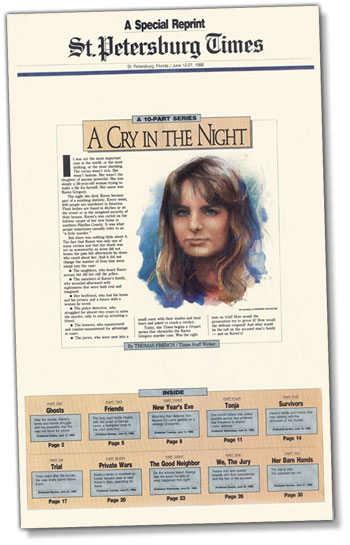
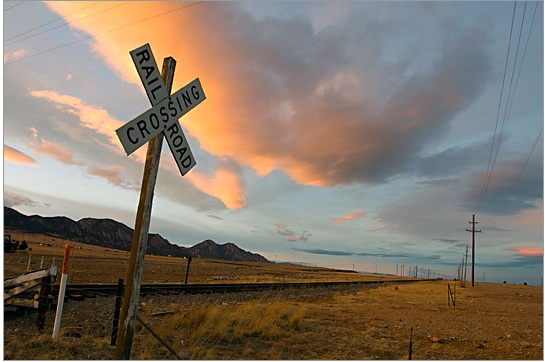
What I am enjoying these days is the online incarnation of some newspapers, particularly those that employ multimedia and narrative writing. One of my mentors, Tom French, has done several huge serial reports for the St Petersburg Times*, but the one-off stories such as the March 8th New York Times article Riding The Rails are just as inspiring and more easily consumable when pressed for time. rr_crossing_outside-boulder-co.jpgThis piece is an interesting short-form narrative, well-reported with occasional first-person interjections for that being-there-with-you feel. The multimedia portion includes images of the amazing landscapes seen while rolling across country and short video clips that allow us to meet some fellow travelers. Is it really just coincidental that only a few days ago I spoke of wanting to travel cross country by train?

* Series by Tom include A Cry in the Night and Zoo Story
zoostory.jpg tf_cry.jpg

Of course multimedia need not be reserved only for narratives. It is not surprising that art reviews are greatly enchanced by visuals. I still refer friends to the slides accompanying a review of Calder works at the Whitney — Calder at Play: Finding Whimsy in Simple Wire (October 2008).

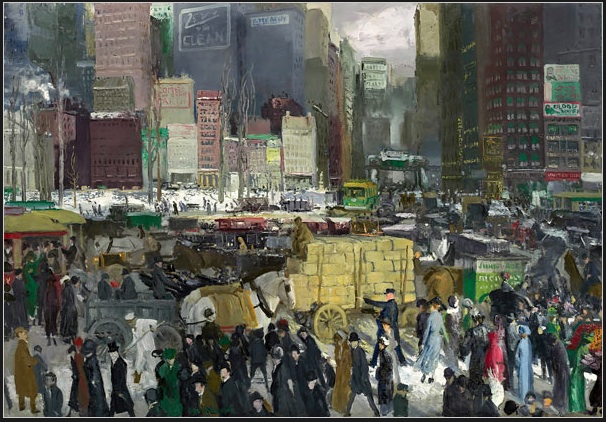
More recently a March 5th New York Times article “The Unheralded Pieces in the American Puzzle” caught my attention, perhaps because last weekend I went to The Getty Museum for the first time in eons and found myself wondering how I might manage to visit there much more often (but that rumination is for another blog post). While the slides with this particular article are fewer and less intriguing to me than those of Calder, I did “discover” artists unfamiliar to me. My favorite is slide number 5, a 1911 painting by George Bellows titled “New York” with this description: “crowded with buildings, vehicles and people in the street, it is thought to depict Union Square in the snow, slightly reimagined and looking west toward the Sixth Avenue El.” ny_bellows.jpgApparently Bellows died young (age 42). His wikipedia entry says “Bellows’ urban New York scenes depicted the crudity and chaos of working-class people and neighborhoods, and also satirized the upper classes.” Had he been of our generations, I wonder what his canvases would portray of life today.

DVT Alert – A Spring Awareness Campaign

I received phone call last week from a publicist at Burson-Marsteller. This was unusual on many counts.

  • 1. it was a phone call (I miss that)
  • 2. I don’t have any personal contacts with flacks there
  • 3. she was calling about a medical story, not my usual beat
  • At first I assumed she found me because of my blog, but I noticed when she followed up via email that she had my writer email address, not my blogger address. Hmmm… She led right off with Deep Vein Thrombosis and she sounded surprised that I knew what that was.

    Deep Vein Thrombosis and Pulmonary Embolisms can be lethal. I’ve never had one, but I well remember the scare. It was during my cancer war days and I, an in-patient, fainted while seated in a wheelchair enroute to my room following a CT scan. When I came to, moments later, I was on a gurney and already on my way to Intensive Care because the doctors feared that I might have thrown a clot. They kept me there for 48-hours, just in case. In addition to the chemo lines, trachea and gastro tubes, I was now connected to the EKG, pulse, oxygen, and other monitors; tethered in every possible way. Those 48 hours were scarier than the cancer.

    DVT occurs when a blood clot forms in a deep vein, usually in the lower limbs. A complication of DVT, pulmonary embolism, can occur when a fragment of a blood clot breaks loose from the wall of the vein and migrates to the lungs, where it blocks a pulmonary artery or one of its branches.

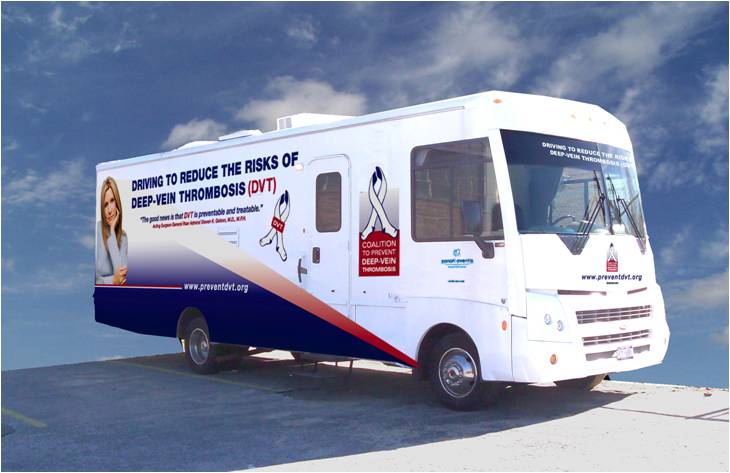
    Anyway, six years ago, March was proclaimed National DVT Awareness Month and the Coalition to Prevent Deep Vein Thrombosis is on a mission to educate Americans about the dangers. Their National Patient Spokesperson is Melanie Bloom, widow of NBC news correspondent David Bloom who died in Iraq due to complications of DVT, and they’ve recently announced Driving to Reduce the Risks of DVT, a nationwide mobile campaign designed to encourage dialogue between healthcare professionals and patients about this serious but preventable condition.

    rv-photo.jpg

    The customized recreational vehicle is currently visiting hospitals and local communities. They started off on March 3rd in Washington DC. On Tuesday the 10th they’ll be in the big apple, stopping first at Rockefeller Center for The Today Show and then the Weill Cornell Medical Center. Another highlight will be a stop at the Metrodome for a Minneapolis Twins baseball game on May 12th, but mostly they’ll be visiting hospitals and universities. Other strops include Richmond, Atlanta, Orlando, Dallas, San Antonio, Pheonix, Sacramento, Las Vegas, Denver, Kansas City, Minneapolis, Columbus, ending in Pittsburgh on May 23rd.

    Here are a few more scary facts:

      Complications from DVT kill more people each year in the U.S. than breast cancer and AIDS combined.
      In the United States, DVT affects up to 2 million people annually.
      Approximately 300,000 Americans die each year from a pulmonary embolism, the majority of which result from DVT
      DVT-related pulmonary embolisms are the most common cause of preventable hospital death

    And here is their factsheet.

    Jazz Ladies In March

    February’s Black History Month is over and April’s Jazz Appreciation Month is coming soon, meanwhile March 8th is International Women’s Day and NPR’s Take Five: A Weekly Jazz Sampler is celebrating with It’s A Woman’s World: Six Jazz Trailblazers featuring Mary Lou Williams, Shirley Scott, Marian McPartland, Geri Allen, Regina Carter, and Maria Schneider. Three of these women are good friends of mine, and from conversations with them over the years I know that they don’t particularly care to be singled out for their gender — “you sure play great” looses something when the unspoken end of the sentence is “for a girl” — but the past-publicist in me says any angle that helps to gain exposure is a good angle.

    Birthdays this month include: Carol Sloane, Shirley Scott, Marian McPartland, Eliane Elias, and Sarah Vaughan.

    Computers – a tool for enhancing communication?

    This really cracked me up, especially now that I’m Mac-enamored. I’m not one who usually passes around jokes via email. A few are indeed funny, but most are just so-so. And who among us has enough time to read them all anyway? Anyway, I found this enactment on YouTube awhile back and I’m still enjoying it.

    I can assure you that this is all too plausible. Here’s the script:

    COSTELLO CALLS TO BUY A COMPUTER FROM ABBOTT . . . .

    ABBOTT: Super Duper Computer Store. May I help you?

    COSTELLO: Thanks. I’m setting up an office in my den and I’m thinking about buying a computer.

    ABBOTT: Mac?

    COSTELLO: No, the name’s Lou.

    ABBOTT: Your computer?

    COSTELLO: I don’t own a computer. I want to buy one.

    ABBOTT: Mac?

    COSTELLO: I told you, my name’s Lou.

    ABBOTT: What about Windows?

    COSTELLO: Why? Will it get stuffy in here?

    ABBOTT: Do you want a computer with Windows?

    COSTELLO: I don’t know. What will I see when I look in the windows?

    ABBOTT: A desktop and wallpaper.

    COSTELLO: I already have a desk with a large top, so never mind the windows with the computer. I just need a computer and software.

    ABBOTT: Software for Windows?

    COSTELLO: No. For the computer! I need something I can use to write proposals, track expenses and run my business. What have you got?

    ABBOTT: Office.

    COSTELLO: Yeah, for my office. Can you recommend anything?

    ABBOTT: I just did.

    COSTELLO: You just did what?

    ABBOTT: Recommend something.

    COSTELLO: You recommended something?

    ABBOTT: Yes.

    COSTELLO: For my office?

    ABBOTT: Yes.

    COSTELLO: OK, what did you recommend for my office?

    ABBOTT: Office.

    COSTELLO: Yes, for my office!

    ABBOTT: I recommend Office with Windows.

    COSTELLO: I already have an office with windows! OK, let’s just say I’m sitting at my computer and I want to type a proposal. What do I need?

    ABBOTT: Word.

    COSTELLO: What word?

    ABBOTT: The Word in Office.

    COSTELLO: The only word in office is “office”.

    ABBOTT: The Word in Office for Windows.

    COSTELLO: Which word in office for windows? I told you I don’t want windows installed in my computer.

    ABBOTT: The Word you get when you click the blue “W”.

    COSTELLO: I’m going to click your “blue ‘W'” if you don’t  start with some straight answers! OK, forget

    that. Can I watch movies on the internet on this computer?

    ABBOTT: Yes, you’ll want Real One.

    COSTELLO: Maybe a real one, maybe a cartoon. What I watch is none of your business. Just tell me what I need!

    ABBOTT: Real One.

    COSTELLO: If it’s a long movie I also want to see reel 2, 3 & 4. Can I watch them?

    ABBOTT: Of course.

    COSTELLO: Great! With what?

    ABBOTT: Real One.

    COSTELLO: OK, I’m at my computer and I want to watch a movie. What do I do?

    ABBOTT: You click the blue “1”.

    COSTELLO: I click the blue one what?

    ABBOTT: The blue “1”.

    COSTELLO: Is that different from the blue “W”?

    ABBOTT: The blue “1” is Real One and the blue “W” is Word.

    COSTELLO: What word?

    ABBOTT: The Word in Office for Windows.

    COSTELLO: But there are three words in “office for windows”!

    ABBOTT: No, just one. But it’s the most popular Word in the world.

    COSTELLO: It is?

    ABBOTT: Yes, but to be fair, there aren’t many other Words left. It pretty much wiped out all the other Words out there.

    COSTELLO: And that word is “real one”?

    ABBOTT: Real One has nothing to do with Word. Real One isn’t even part of Office.

    COSTELLO: STOP! Don’t start that again. What about financial bookkeeping? You have anything I can track my money with?

    ABBOTT: Money.

    COSTELLO: That’s right. What do you have?

    ABBOTT: Money.

    COSTELLO: I need money to track my money?

    ABBOTT: It comes bundled with your computer.

    COSTELLO: What’s bundled with my computer?

    ABBOTT: Money.

    COSTELLO: Money comes with my computer?

    ABBOTT: Yes. No extra charge.

    COSTELLO: I get a bundle of money with my computer?  How much?

    ABBOTT: One copy.

    COSTELLO: Isn’t it illegal to copy money?

    ABBOTT: Microsoft gave us a license to copy Money.

    COSTELLO: They can give you a license to copy money?

    ABBOTT: Why not? THEY OWN IT!

    A FEW DAYS LATER . .

    ABBOTT: Super Duper Computer Store. May I help you?

    COSTELLO: Your people set up this computer in my den and turned it on, but how do I turn it off?

    ABBOTT: Click on “START.”

    Lukas Foss, R.I.P.

    Lukas Foss, Composer at Home in Many Stylistic Currents, Dies at 86 (The New York Times obit) Back in June of 2007 Laurie (my girlfriend from elementary school days) was in the chorus of the revival of Lukas Foss’s major cantata, “The Prairie.” It had been decades since this work was heard in a New York performance.

    The concert at the Rose Theater celebrated Foss’s 85th birthday, and he was present for the concert celebration. Professional soloists were backed by the Brooklyn Philharmonic and The Greenwich Village Singers (Laurie has been a longtime member) with the Choral Society of the Hamptons forming a chorus of over 100 voices.

    Laurie said the piece reminds her a bit of Gershwin, with some Copeland-esque sounds, “but it is not at all derivative–in fact, it’s wholly original and just a very cool piece of music. Very difficult not to like, even for those of you who do not ordinarily listen to choral music.”

    You can read more about An American Awakening: The Rediscovery of a Choral Masterpiece on The Prairie Project website. The text, which was adapted by the composer from Carl Sandburg’s “The Prairie,” is posted there, along with the composer’s commentary a seen in the program from the 1944.

    A Violinist in the Metro

    A Violinist in the Metro is the subject of a viral email that I received just this week. The story it tells, of renowned concert violinist playing in a Washington D.C. subway during rush hour who goes unrecognized and unappreciated, is true. The violinist was Joshua Bell and it was widely reported, by the Washington Post and NPR among others…two years ago. The event took place on on January 12, 2007 and I don’t know why this email is circulating now but it bears re-telling for it gives rise to questions that are worth considering.

    The email concludes with this question:

    If we do not have a moment to stop and listen to one of the best musicians in the world playing some of the finest music ever written, with one of the most beautiful instruments …. how many other things are we missing?

    It’s a good question, but I would also have to ask whether the adults, who probably had no arts education or even exposure to the arts, would have had the ability to discern quality and beauty even if they did have the time to stop and listen. Some might argue that art has the power to touch all, and I might agree, but I also think that those who grew up in recent times may have had the innate ability with which we are born sucked out of them by adulthood. (The children in this story wanted to stop and listen, but the grownups pulled them away.)

    It reminds me of a story I read some time ago about people are born with the ability to taste color or see musical notes as colors and shapes but the ability fades away from disuse, lack of encouragement, lack of adult understanding… It’s called synesthesia (“a rare neurological condition in which two or more of the senses entwine”) and while I am not a scientist, I do believe that we are born with way more abilities and talents than we ever imagine, let alone nurture.

    What do you think?

    Best interests?

    The issues are no longer clear cut. Maybe they never were, but now, I think, less so than ever. For example, are unions good or bad? There was a time when unions did a tremendous service, fighting for the rights of commenfolk. But today we seem to be in an age of me, me, me, and I wonder if the demands being made to supposedly protect the worker are out of line with common sense. Don’t get me wrong, I am not an advocate of corporate greed, and I would be the first to confiscate the obscene bonuses and out-sized salaries of the suits at the top. But take a look at this video report about Ford’s manufacturing plant in Brazil and tell me what you think. Is Ford doing “the right thing”?

    Sunday morning correspondence

    This morning’s email brought links to three CD reviews: two about Hemispheres (Jim Hall/Bill Frisell with Scott Colley and Joey Baron) in The Independent newspaper in London and State of Mind, and the third was in JazzReview about Brother to Brother (John, Jeff and Gerald Clayton with Terell Stafford and Obed Calvaire). As you may know, I’m a fan and it just so happened that as 2008 drew to a close I had a last-minute assignment to write press releases for these two ArtistShare recordings. I have become so used to reading articles and reviews from around the world that I have to remind myself just how amazing it is that we can be so connected with the whole wide world…and how exhilarating as well as overwhelming that can feel.

    Social networking is a part of that mix and as I just wrote to Orrin Keepnews this morning, “this social networking stuff is crazy and can be time consuming, but it’s fun, people post some wonderful videos and pictures, and it feels good to be connected.” I am trying to juggle the feel-good nature with the usefulness factor, exponentially confounded by three networks — Facebook more social, Linkedin more biz, and I haven’t figured out the point of Twitter yet but you can follow me. All I know is that I can now use HelloTxt to post status messages to Twitter and Facebook simultaneously…for whatever that’s worth. Does anybody really need to know, or care, that I’m about to brew a pot of coffee or head off to pilates?

    What do you think? Are DevraDoWrite readers signed on to any of these networks? Why or why not? Do you read publications from afar and if so, how often? Please post your comments or email me directly.