I mentioned making a quick trip to New York earlier this month. It was a last minute decision to attend a school reunion. The fact that is was an elementary school reunion seems to be of much amusement to my friends from recent years. It wasn’t until I noticed their amused or bewildered reaction that I realized, or rather remembered, just how unusual, and privileged, my early schooling was — privileged for two reasons, neither of which being that it was a private school. The first reason is the school’s philosophy, described today on their website as follows:
“Education at the School is experience-based, interdisciplinary, and collaborative. The emphasis is on educating the whole child — the entire emotional, social, physical, and intellectual being — while at the same time, the child’s integrity as learner, teacher, and classmate is valued and reinforced.â€
The School for Children is a demonstration school for what is now known as the Bank Street College of Education. When it began in 1916 is was the Bureau of Educational Experiments, a research group founded by Lucy Sprague Mitchell. The group decided that they could best study child development, with the fewest restrictions, if they had their own school, so they started with a nursery school in 1918. Mitchell was not the only one with progressive ideas, a Dewey-esque learning by doing approach; her two colleagues, Caroline Pratt and Elisabeth Irwin also founded schools in Greenwich Village, City and Country School and Little Red Schoolhouse, respectively. And when BEE’s kids “graduated,†most continued their education at one of those schools.
In 1930 the school acquired and converted the old Fleishman’s yeast factory at 69 Bank Street, that was the building where we attended school, but it was not until the late 50s that they decided to start adding classes so that the oldest students could stay on…and so that they could continue to study us and train teachers in our classrooms. When we graduated from 8th grade we were only the third class to do so. We were 69 Bank Street’s Class of 69. We were a special group; I thought that then, and I still do.
The second privilege, likely a result of the first, is that my little class (class size was always small, about 18) was more like a family than a class, and that closeness became evident once again when we began to reconnect. Half of our class attended school together, grew up together, for nine, ten, and eleven years. Although most of us had not been in contact since our only prior reunion in 1994, and some had been out of touch since graduation, it was as if the intervening years melted away – the fondness of one another, the school, and I suppose our lost youth, coupled with curiosity, eroded any obstacles. Of course we are each closer to some than to others (as it was then, so it is still today), but if old sibling-like rivalries existed in the past, they are no longer evident and the strong bond forged in the 1960s remains today.
Soon after we graduated the school moved uptown, grew in size, and its attitudes changed with the times. Their focus shifted to their immediate operations and they lost track of and interest in their graduates. They even lost our records. We found that out when we organized our own reunion twelve years ago. Of course their interest peeked when someone told them of our 25th-year reunion and gave them addresses – suddenly they were interested…in our checkbooks.
Most of our teachers are gone now, a few retired or moved on to other careers, but many have died. They were the ones who, with guidance from the educators at the college, saw us through. We are happy to have also reconnected with Pearl Zeitz, our 7s teacher (we didn’t have “gradesâ€), and Peter Sauer, our science teacher who came on board during our last two or three years because parents began to get nervous about how we would fare in “the real world.†And of those no longer with us there are a few who we miss and remember fondly: Hannah McElheny (6s), David Wickens (8s), Betty Crowell (9s), Muriel Morgan (10s and 13s), and Hugh McElheny (music). The educators who studied us are long gone, replaced by administrators and fundraisers. I’d like to think that Lucy Sprague Mitchell, Barbara Biber, Edna Shapiro, John Neimeyer, and others at the College, along with our teachers, would have wanted to know how we, their experiments, turned out. I think they’d all be pleased.

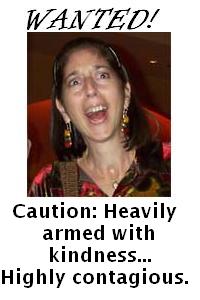 A warrant has been issued for my arrest! I have been charged with having a big heart and will be apprehended on August 17th. As one of the “Most Wanted” I am going to be “Locked Up” to benefit the Muscular Dystrophy Association. You can help by contributing to my bail. They may even let me out on good behavior. My bail has been set at $1800, just enough to send three children to MDA summer camp. They tell me that I have an opportunity for immediate release for good behavior if bail is raised prior to the court date.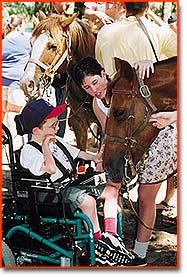
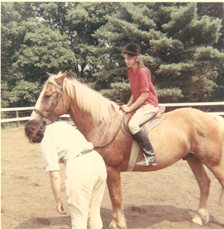 I was three or four years old when I first met a horse. My mother and I were living out West and because she took me almost everywhere with her, I got to go riding at an early age. I won’t claim to have a vivid memory of this, but I feel like I remember it. I have some other very clear memories of that time in my life, clearest being the floor plan of our house in the cul-de-sac. I remember going to the hospital emergency room when I punctured my ear drum, swallowing a quarter, digging for worms, twirling a baton (or trying to), playing with a lamb (a real live one), eating a dog’s Milk Bone, and riding in a jeep. And I remember the picture on the wall over my bed. But my memory of riding a horse is hazy, just a feeling, perhaps from photos I’ve seen long ago, perhaps not. Still, it must have been a good experience because seven or eight years later I became a pretty good rider, albeit back on the East Coast and in an English saddle. The photo at left is yours truly at summer camp, age 11.
  So here I am, at it again; the picture on the right is from yesterday. I’ve been going once a week and this is my third time. The first time the trainer put me on Contessa. She’s an older horse, stubborn but not wicked like some of the 3 year olds. We stayed in the arena that day and Contessa ran the show; I was just happy to stay seated. Last week, a friend went out with us and they convinced me that I could handle Flicka. I was doing fine in the arena, but then my friend talked me into going out on the trail. Wow. Or more appropriately, Whoa. First of all, to get from the stable to the arena you have to ride down the street with an occasional car passing by. The horses seem used to the cars, but lawnmowers spook them. The arena is in a large park, but to get to the trail you have the leave the park and ride down Lincoln Avenue, a fairly major street. At times, we rode on the sidewalk. The only thing missing were the hitching posts. Given the price of gas right now, perhaps not a bad idea. It was an exhilarating trip, even if half of the exhilaration was just plain terror. I acquitted myself well, and had some measure of control over Flicka, though I suspect only as much as she allowed me. This time it was back to Contessa and I stayed in the arena. We battled a bit, but I felt more in control. I went out in flat shoes because last week my ankle gave out and it may have been due to the heels on the boots I was wearing (I haven’t worn shoes with heels in more than six years). This felt a little better, so perhaps I’ll treat myself to some boots without heels. We’ll see. Gotta keep those heels down.