Let Me Off Uptown

Tomorrow’s edition of “Jazz From the Archives” on WBGO radio features jazz vocalist Anita O’Day. You’ll hear tracks from O’Day’s 1952-62 work (thought by some to be her best recording years) on the Clef and Verve labels, with such arrangers as Russell Garcia, Jimmy Giuffre, Bill Holman, Quincy Jones, Johnny Mandel, Billy May, and Gary McFarland, plus small groups led by Gene Harris, Roy Kral, Oscar Peterson, and Cal Tjader.

Way back when, in my NYC hanging days (that would be about 30 years ago) I got to hear Ms. O’Day quite a bit in person at Michael’s Pub, an upscale room on East 55th street. Norman Simmons was her pianist then and I loved every minute of it. In those days I also used to go over to Jimmy Ryans club where Roy Eldridge ‘s group was in residence (Dick Katz on piano, Major Holley on bass, Eddie Locke on drums) and the standard repertoire always included Roy’s imitation of Anita singing “Let Me Off Uptown.” (here’s the original version)

“Jazz From the Archives” featuring Anita O’Day airs tomorrow, Sunday, March 18, from 11 p.m. to midnight, Eastern Daylight Time.

Affirmative

I have long had mixed feelings about events, awards, competitions, clubs, schools…that are segregated, i.e. that are solely for the benefit of one group to the exclusion of others. Separation based on race or age or sex or religion or whatever feels divisive and exclusionary. On the other hand, there are many good reasons to reach out to a specific narrowly focused group. Some will argue that disenfranchised groups need targeted opportunities to receive services and benefits to which they would not otherwise have access. Others will argue that two wrongs don’t make a right and will point to individuals who have found the ways and means to achieve their goals regardless.

It’s been awhile since affirmative action was a hot news topic, so why am I talking about it now? I just received an email and flyer from one of my writing mentors. Marita Golden saw a lack of institutional resources in the African American community dedicated to supporting creative writing either as an artistic expression or a professional endeavor. So she and a colleague created the Hurston/Wright Foundation to discover, develop, and honor Black writers. Now she was writing to announce a new Writers’ Week Workshop to take place in Washington DC in July, where an international community of Black writers will meet in a nurturing/safe space to discuss their work, its meaning, and unique aesthetic.

I’ve been debating with myself about whether or not I want to help them spread the word. I decided in the affirmative. Recognizing that such a unique aesthetic exists and should be nurtured, explored, developed and understood is a good reason for selective inclusion and therefore something I can support as an outsider. Plus they are offering a special tuition-free track for high school students, and I’m all for nurturing young writers. So if you know any aspiring African-American writers in high-school, please tell them about this opportunity. (Info and application details are here)

March Madness?

I just came across this quote in the February 2007 issue of The Writer magazine:

“I can’t write quickly. If I could write a book a year and maintain the same quality, I’d be happy. I’d love to write a book a year, but I don’t think I’d have any fans.” Donna Tartt, as quoted in the London Sunday Times

I’ve seen the work of many a hack who publishes pounds of fish-wrap in short order, but there are those writers — and bloggers — who can, and do, churn out what seems to me to be massive amounts of high-quality prose in short time-frames. (TT comes to mind.) I am not so consistent, though when I know what I want to say it does come more quickly and with greater ease. My delays are usually caused by a slow-down in thinking more so than hand-cramps. Either I haven’t worked “it” out yet or I haven’t even had time to think about it. When it comes to blogging, it is usually the latter.

Were I to dare call my writings “art,” I might invoke these words by Glenn Gould

“The purpose of art is not the release of a momentary ejection of adrenaline but rather the gradual, lifelong construction of a state of wonder and serenity.” — from his 1962 essay Let’s Ban Applause!

implying that gradual construction might apply to the creation as well as the resultant experience.

In any case, I am sorry to be so often missing-in-action from the blogosphere, but it’s certainly not for laziness or lack of interest. I think about it daily and often dash off the beginning lines of a post or file away a note of interest for later…then later gets delayed. I also keep intending, and forgetting, to respond to blog comments. I’m not sure, though, whether I should respond with a comment myself, or in a new post. So here are a few aggregated thoughts:

1) In a post about Erroll Garner I excerpted John’s story about playing on Erroll’s very first recording. I distinctly remember someone commenting that the album John spoke of was not Erroll’s “first recording”, and not even the first with John playing bass with him. I can’t for the life of me find the posted comment (maybe it was removed by the sender) or perhaps it was email that I can’t find, but I did intend to answer it. The sender (I don’t remember who it was) made reference to an earlier recording in connection with Timme Rosenkrantz. According to John, who qualifies as a primary source, after hours lots of musicians would hang out at Timme and Inez’s home, jamming. Some may have been aware at the time, others not, that Timme was taping them, but they certainly weren’t “making a record” for release. So while someone mayhave captured Erroll on tape before then, it is John’s opinion that Erroll Garner’s first intended, or official, or professional recording was made for Savoy Records on September 25, 1945.

2) Under the Art & Music post about Ted Nash’s new suite, my mother commented that back in 1993 my dad recorded “Dedications and Inspirations,” a CD with three pieces inspired by Miro, Matisse, and Monet. True, but Dad does not claim to be the first. While interesting, published discogrphies are not always 100% accurate. I do not own, nor have I heard, any of the following, so I share these results of a quick discographic database search with the usual caveat lector warning.

— a 1968 recording by Astrud Gilberto with unknown accompaniment with the title “Lillies by Monet”
— German pianist Siegfried Kessler’s 1976 recording Les Mots Sont De La Musique that includes “La femme en blue d’Henri Matisse”
— a 1987 solo piano recording titled “Water Lilies: Richie Beirach Plays Musical Portraits Of Claude Monet”
— “Homage To Joan Miro” by the Emil Viklicky Quartet recorded in Prague, 1987
— Slalom, a 1988 recording by Jane Ira Bloom with Fred Hersch in piano that includes two tracks “Painting over Paris” and “Miro”  

Tangentially, I’d like to add that I have long been fascinated by the interplay of the arts, especially artists who themselves are multi-talented, people like Tony Bennett and Miles Davis.  And not just musician/painters, works by actor/painters such as Martin Mull, Richard Chamberlain, Gene Hackman, and Sylvester Stallone have also been sold at charity auctions and at galleries.

3) In Your Eye would have been the title of my response to TT’s first posting from Los Angeles. I had planned to tell him that the majority of us who live in what is loosely called L.A. do not live in any of the places he mentioned — many live “in town” which includes the Wilshire district and the increasingly popular downtown L.A., but even more of us live in other towns, from San Pedro to Pasadena, to Thousand Oaks and beyond. I also wanted him to know that in my nearly 30 years of living out here on the left Coast I have never, ever, dined at an In-N-Out Burger, and I set foot in Westwood as seldom as possible. So when he writes, “I’d say that was a real Los Angeles evening, wouldn’t you?” I would have to reply, “not hardly.”

I’d call my disappearing act March Madness but it’s been going on for months now and, as I steadfastly refuse to give up on trying to multi-task, it may be a persistent on-again off-again condition. If you’re reading this, it means that you have been hanging in there with me, for which I thank you very much.  (Of course, you could be a brand new reader of DevraDoWrite and I may have just scared you off….).  I’ll be back as soon, and as often, as I can.

On the air now

Just this moment received an email from old school chum Denardo Coleman. Yup, the drumming son of Ornette and I went to elementary and high school together. He just heard my dad and Ornette on the radio:

Every year radio station WKCR here in NY does a 24 hour ornette birthday broadcast, you can hear it today. Just heard your dad with him. http://www.columbia.edu/cu/wkcr/

Check it out.

I recently heard or read that the cost of internet radio fees was going to be so high as to be unaffordable to the broadcasters, so listen now, while we still can.

Art & Music

I see that artist Paul Harryn has commented his thank yous on the post below (click here to read) and I note that in doing so he did not foist upon us a link to his work. I use the word “foist” rather tongue-in-cheek because it is perfectly acceptable these days (perhaps even advisble) to take full advantage of any and all networking opportunities, especially on the Internet. Anyway, his omission fueled my curiosity and I turned to Google where I found a link to Monsoon Galleries and quickly fell in love with a number of works, none of which I can afford at this time. Take a look at Sounds of Sevilla, a pastel on paper that he did in 1993 and the three-foot square acrylic-on-wood from 1999 titled Paris Paintings: Passages.

He’s no stranger to jazz (the 1991 and 1998 Newport Jazz Festival posters are his), but he’s no Johnny-One-Note. His works vary in mood, and as I read more about him, his thoughts and approach, his words clearly expressed the empathy between the arts. He writes of his “interest in contour line drawing and being able to capture the essential gesture of a figure or event and the ambiance and mood of the environment…[and] in having my work express an idea and communicate with the audience.”

And to me, this next pararaph might well apply to my work as a biographer:

Since my work is informed by a diverse number of sources, I’m often presented with the challenge of merging these ideas and techniques into a decipherable and homogeneous format. As a result my paintings are multi-layered, sometimes consisting of as many as fifty paintings and/or events on one painting. Through each layer or sub-painting I decide what is most pertinent, interesting, and innovative. I apply a resist to those areas to ‘save’ them while I apply yet another layer or sub-painting; remove the resist and continue this process fifty or sixty times. Sometimes what I saved previously does not make it to the final edit. It’s a very fluid and Darwinian process resulting in paintings that come to conclusion when they achieve an innate balance between past and present.

While I’m on the subject of visual arts and jazz, you should also check out the wonderful video report by Nate Chinen at The New York Times. It’s about a seven-movement suite called “Portrait In Seven Shades” composed by saxman Ted Nash on commision for Jazz at Lincoln Center’s “Jazz & Art” concert. The report beautifully integrates the images Nash chose for inspiration with some rehearsal clips and interview in which Nash talks about his process. The suite will debut this weekend, Thursday, February 22nd through Saturday the 24th at Rose Hall where, according to NY1, the images of the artworks will be projected on stage during the performances.

Open Ears

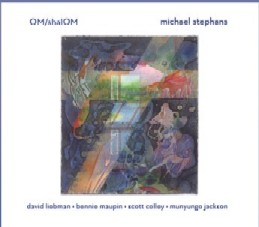
A year or so ago drummer Michael Stephans (then my neighbor down the street, since moved East) offered to play for me his latest recording, OM/ShalOM, which had not yet released. Now Michael is a first-class drummer, and, as his bio tells you, not only do his compatriots include Bob Brookmeyer, Pharoah Sanders, the late Charlie Byrd, Don Menza, Buddy Colette, Alan Broadbent, Bob Florence, Mike Melvoin, Lynn Arriale, Bud Shank, … but he has also played with personalities as wildly diverse as The Rolling Stones, Cher, David Bowie, Shirley MacLaine, and Natalie Cole. Still I was hesitant because I knew this was an unusual recording, a fusion of well-known Hebrew liturgical songs and Yiddish-based melodies with modern improvisational music. Michael is a deep guy (he’s got a PhD, two Masters degrees and he’s a poet too), and I was afaid that this music would be over my head, too ‘out there.’ Forgive me here, but I thought, “Oy vey. What will I say?”

OMSHALOMCover.jpgAlmost immediately I was sucked into this vortex of sound, much of it feeling very primal. Five musicians (Michael, David Liebman, Bennie Maupin, Scott Colley, and Munyungo Jackson), each a major player in his own right, charted deep waters but always came safely back to shore. Part of what drew me in was the familiarity of the melodies – Let My People Go, Shalom Alechim, and Hava Nagilah to name a few – but I think it was the timber of the horns, the undulating steadiness of the beat, and the intensity of emotion that kept me afloat and attentive throughout. The CD, with a beautiful cover by Paul Harryn, includes a few of Michael’s originals including the title track, Kaddish for Elvin, and Moon Over Miami that is a poem set to music.

Now I am pleased to share with you the news that OM/ShalOM will celebrate its New York premiere and CD release on Monday evening, February 26th, 2007 at the Blue Note in New York City. And for those of you in the vicinity of the Poconos, you can hear a preview on Sunday, February 25th at the Deerhead Inn.

Grammys Not In The News

Nancy Wilson won a Grammy last night, not that anyone would know from the media coverage. Had you been in the audience yesterday, during the pre-telecast awards when 96 Grammys were bestowed, you would know that only two of those winners garnered standing ovations: Tony Bennett and Nancy Wilson. No Standing O for Peter Frampton or Bon Jovi or Ludacris, just for Nancy and Tony.I have to believe that means something. The mainstream media has decided that jazz is irrelevant and/or of no interest to it’s readers/viewers. This decision is based, of course, not on any journalistic standards but solely on commercial concerns and advertisers allocations. Tony Bennett, having allied himself with pop, rock, and country performers, has broken through the barrier, and Michael Brecker’s win was mentioned in some reports because his death from a dreadful disease was recent news. Please don’t misunderstand my rant, Michael was most deserving, but I suspect that had he been alive and well his Grammy win would not have been mentioned outside the inner jazz circles. And that is a shame to be sure.

In their quest for young audiences, the gatekeepers have determined that older artists are not of interest, but they are wrong. If I had a dime for every fan letter and email that Nancy receives from fans under the age of 30, I would soon retire. It reminds me too of another recent experience with The Los Angeles Times. My father was making a rare Los Angeles appearance, he hadn’t performed here for a few years, he had recently been named an NEA Jazz Master, composed and performed an orchestral work with the Baltimore Symphony, in short there was lots of unusual and interersting news. The writer we pitched wanted to do an article but the newspaper editor said ‘no,’ the combination of his age and his music, jazz, added up to “no interest.” I wish that editor had been at the concert to the see the room full of high school and college kids.

Its a sad world where the majority doesn’t stand up to the media…and the government. If we don’t voice our demands then maybe we deserve what we get.

Thoughts upon awaking this morning

Did I choose the wrong metier? — I am a writer and as such my medium is the printed word. I am a biographer, charged with bringing people to life on the printed page. But even as I am in the midst of researching the Luther Henderson biography and writing People On The Page, a book about the process and nature of writing biographies, I have become mesmerized by multimedia, intrigued by video podcasts. Indeed I am becoming jealous of those whose have what I perceive to be the luxury of using audio and visual components in crafting their pieces.

Yesterday I watched online a new podcast created by Bret Primack for Sonny Rollins’ website. Bret does not have to struggle to find the words with which to describe Sonny’s intensity, or his warmth, or his prowess, when you can see and hear and feel it for yourself. Now don’t get me wrong — I know that what Bret does is not easy. Scripting, shooting, directing, producing films of any length is its own art form with it’s own dilemmas and challenges…I wish I knew how to do what he does so well! I remember too my reaction to the NPR radio piece that Sara Fishko did about John in January of last year — it was so good that it brought tears to my eyes and I told Sara then that I was in awe of her ability to distill someone’s very essence into the space of only several minutes. Her audio-only segment had, in my opinion, more emotional depth than the NEA’s very excellent biographical video clip about John, so clearly it’s not the added media component alone that makes the difference.

I am what I am, and will comfort myself with the thought that perhaps, on occasion, one of my finely-crafted sentences will evoke the envy of a videographer…the grass IS always greener, isn’t it?

I also awoke thinking about ways in which I can explore and incorporate the parallels between the work of a psychotherapist and that of a biographer — not only the reconstruction of a life, but also the nature of the relationship between biographer and subjects/sources and the complexities of transference and counter-transference. While in NY earlier this month I was telling a psychoanalyst friend about People On The Page and she said “hmmm, that’s a lot like the work that I do.” Then a few nights ago I had a conversation with a writer friend who is also a therapist and he agreed that there were similarities between the work of therapist and biographer. Okay, this is not a giant revelation; apparently it was not even a new thought to me, but one that had slipped my mind. So, just to be sure I was paying attention, the universe sent me another reminder message yesterday. While reviewing my note files, I came across an excerpted quote taken from an August 2000 newspaper article, “Writing from the Heart but Drawing on the Mind,” about novelist Amy Bloom. She said, “Some of the traits that led me to be a psychotherapist are the ones I find in myself as a writer. I’ve spent a lot of time listening to people, and I’m endlessly intrigued by relationships, particularly the gap between what people say and what they truly feel, and the gap between what they do and what they really want.” One might be able to ignore a one-two punch, but this thought has now come up three times in ten days, so I had best pay attention.

Another related thought has also reached my consciousness — with my mother being an analyst and my father a jazz musician, I am following in my parents’ footsteps as a biographer of jazz artists. Hmmmm….

Through Their Eyes

A few years ago, while in Washington, DC, I met a young photographer named Shawn Davis at a showing of some of his work shot in Cuba. It was the first time I ever bought a work of art directly from the artist, and, I believe, the first time I ever bought a photographic work of art (posters and museum prints in my younger days don’t count). Periodically I receive an email from Shawn and I am pleased to share with you news of his latest project — Visual Griots of Mali: African Children Tell Their Stories with Cameras. I have seen some of the childrens’ work online and I also bought the Spring 2006 issue of African Arts (published by The James S. Coleman African Studies Center, UCLA International Institute) that has a feature story about the project with wonderful accompanying photos, but this is an exhibit that I wish I could see in person.

(Actually, to be perfectly honest, this is the sort of project with which I wish I could be personally involved. To empower young people to share their stories and viewpoints — well, you can easily see that it’s an ideal quite compatible with my penchant for biography, especially those of the “less than famous.”)

Visual Griots of Mali
is the result of a project in which U.S. and Malian photographers helped the youth of the country create their own photographic documents of their lives. If you are in DC on Saturday, February 24 do yourself a favor and join Shawn at the National Museum of Natural History (Baird Auditorium) where at 12:00 noon he will not only introduce this landmark exhibition, but also screen the short film Malick Sidibé: Portrait of the Artist as a Portraitist (2006, 8 minutes). Here’s an excerpt from Shawn’s email:

This event, free and open to the public, is an opportunity to celebrate the enormous success of the 22 young students in Mali, West Africa …This will be a great chance to hear updates on how the photographs were received in Mali, what the local communities have to say about the project, how local DC area youth have been involved in the project, and what the President of Mali had to say about it all!! I’ll be giving a lecture that I promise will be full of fun photos and video footage. We hope to see you there. Please share this with your friends, family, and colleagues. The lecture hall is right next to the exhibit, so if you haven’t seen the show yet you can do both in one shot.

And if you can’t make the opening event, you have until April 27th to view the exhibit at the Smithsonian — then it’s on to Kansas City.

The exhibit is sponsored by the Academy for Educational Development and NMNH Office of Visitor and School Services.