
Okay, I’m at least twelve hours late. I intended to post a quick entry this morning about Capote, the movie, which I saw and liked very much, but along the path to posting I got waylaid thinking about the fact versus fiction argument that springs eternal, especially when Capote’s name is mentioned. Before I lead you through my own digression, let me say that the acting in the three main roles — Philip Seymour Hoffman as Truman Capote, Catherine Keener as Nelle Harper Lee, and Clifton Collins Jr. as Perry Smith — was outstanding. Their characterizations were incredibly understated and immensely powerful, no small feat, especially for the role of Truman Capote.
The movie is based on the book Capote by Gerald Clarke, which I have not read. Actually, I had not even planned to read it, but after reading Capote: A Biographer’s Story, a two-page essay in the Sony Pictures press kit (pages 5 and 6) in which Gerald Clarke explains how he came to write the book, with Capote’s cooperation, I think I will read the biography. In a process that lasted more than thirteen years, Clarke personally met and got to know all the main characters, except of course the two killers who were executed so he based his knowledge of them on the lengthy letters they wrote to Truman.
Clarke reports that he worked closely with screenwriter Dan Futterman, allowing him to use the letters to create dialog for the movie. Bennett Miller, the film’s director, and Philip Seymour Hoffman, who plays Truman, peppered him with questions about Truman’s habits and gestures, and Hoffman studied audio tapes of his conversations with Capote to recreate Truman’s voice patterns and inflections. Clarke believes that Hoffman “has done more than impersonate Truman. For the length of the movie he has resurrected him.â€
That’s a ringing endorsement if I ever heard one, so I have no reason to doubt the veracity of the movie or the book…unless I choose to question Clarke’s ability to ferret real fact from Truman Capote’s self-serving, ego-aggrandizing reflections and recollections, or wonder if Clarke’s relationship with Capote was fraught with the same quality of duplicity that permeated Capote’s relationship with Perry.
It would be an easier existence if things could simply be right or wrong, true or false, fact or fiction, but like water is to earth, 70-75% of life seems to fall within the gray area, neither black nor white, fish nor fowl.
I don’t know how accurate Capote is, and, to a certain extent, it doesn’t matter. A film, I have always believed, must work within its own parameters; its faithfulness to its source material is secondary, if it matters at all….
To which Terry Teachout replies
O.K., I take the point—but what if the “source material†is the historical record? Does it “matter†if an artfully made docudrama contains significant distortions that large numbers of ordinary folk come to regard as the whole truth and nothing but?
Just asking.
I draw a line between the fictive nature of one’s memory and the conscious manipulation of information. I also draw a line at lying to one’s readers. I was outraged when I learned that Capote had created a fictional ending for In Cold Blood, but Edmund Morris’ use of a fictional character in Dutch: A Memoir of Ronald Reagan, did not bother me because he not only disclosed, but explained the use of this literary license up front, describing it as ” a literary embodiment of the biographer’s own persona.” In the case of John Berendt’s Midnight in the Garden of Good and Evil, I was disappointed to read his admission, at the very end, that he had “taken certain storytelling liberties, particularly having to do with the timing of events.” At least he did not keep it secret. His rationale? “Where the narrative strays from strict nonfiction, my intention has been to remain faithful to the characters and to the essential drift of events as they really happened.”
When writers say things like that, or use phrases like “the greater truth,†I have to wonder what a writer can possible do to make the truth greater than it really is. Some writers talk about the narrative needs, good storytelling forms and conventions, to which I say, if you can’t tell a story the way it really happened, go write a novel.
Yes, I know that’s my simplistic side talking, the one who sees only right and wrong. So when in doubt, I consult the masters of my craft, people such as Roy Peter Clark and Lee Gutkind.
Clark is a Senior Scholar at Poynter Institute, a non-degree school for journalists in Florida. In his piece titled The Line Between Fact and Fiction he wrote:
Hersey [author of Hiroshima] draws an important distinction, a crucial one for our purposes. He admits that subjectivity and selectivity are necessary and inevitable in journalism. If you gather 10 facts but wind up using nine, subjectivity sets in. This process of subtraction can lead to distortion. Context can drop out, or history, or nuance, or qualification or alternative perspectives.
While subtraction may distort the reality the journalist is trying to represent, the result is still nonfiction, is still journalism. The addition of invented material, however, changes the nature of the beast. When we add a scene that did not occur or a quote that was never uttered, we cross the line into fiction. And we deceive the reader.
This distinction leads us to two cornerstone principles: Do not add. Do not deceive.
Gutkind, despite being derisively dubbed the “Godfather of Creative Nonfiction†by James Wolcott in a Vanity Fair article a few years back, is a much respected author and teacher – actually the first to teach a creative nonfiction writing course at the university level. In The Creative Nonfiction Police, a December 2001 article in AWP (Associated Writing Programs), Gutkind asks:
Are we more deceived by Truman Capote, who did not take notes and relied on memory to retell the horrible story of the murder of the Clutter family in In Cold Blood, or Michael Chabon who disguised real characters and situations in his novel, Wonder Boys?
Maybe the issues are cloudy and the answers gray, but Gutkind does have a prescription for creative nonfiction writers:
First, strive for the truth.
Second, recognize the important distinction between recollected conversation and fabricated dialogue.
Third, don’t round corners—or compress situations or characters—unnecessarily.
Fourth, one way to protect the characters in your book, article, or essay is to allow them to defend themselves—or at least to read what you have written about them.
His conclusion:
Wherever you draw the line between fiction and nonfiction remember the basic rules of good citizenship: Do not recreate incidents and characters who never existed; do not write to do harm to innocent victims; do not forget your own story, but while considering your struggle and the heights of your achievements, think repeatedly about how your story will impact on and relate to your reader. Over and above the creation of a seamless narrative, you are seeking to touch and affect someone else’s life—which is the goal creative nonfiction writers share with novelists and poets. We all want to connect with another human being—as many people as possible—in such a way that they will remember us and share our legacy with others.
My conclusion:
Amen, and have a great weekend.
And oh, if you haven’t seen Capote yet, go.
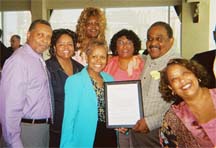 Speaking of photos, I just got a photo from the retirement party in Atlanta (read about it
  I’d really like nothing better than to stay in bed today — the weather is perfect for it (overcast and damp) and I am catching a cold (the first one in a very long time, years, I think) — but it is not to be. Today I must pack up the kitchen in preparation for renovation. Demolition is supposed to start on Monday. Demolition is really too strong a word, we’re not gutting and rebuilding; in fact the floor plan will barely change…well, maybe just a little. The refrigerator will shift position opening up a space to extend a secondary counter just a tad. The cabinets will get a facelift, and a few will be reconfigured on the inside so that the deeper recesses will have pull-out shelves for easier access. But the real deal is the kitchen counter, which is huge (12′ x 4′), central to the house and opens to the family room. This will become the design focal point of the space with bold new tiles. (Can you tell I’ve been watching too much HGTV?) I don’t like small tiles or lots of grout, so the tiles are 13″ X 13″ Galaxy Red — the name is deceptive as the color is not red at all; really more reddish-brown with golden tones.
 You learn a lot when you do these projects (No, I’m not doing the work, just the planning). Tiles are much less costly than slabs of granite or marble, but they get you on the trim pieces. Whatever the tile might cost per square foot, the V-cap (that’s the counter edging) might cost eight to ten times as much for a 6-inch piece. Same goes for the corners and beaks. I got around this by abandoning the Galaxy in lieu of complimentary but less expensive trim pieces from a different company.