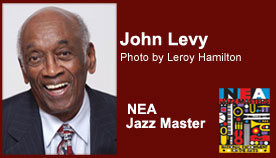
A Correction

George Ziskind, the correspondent who sent in the report about the Sonny Rollins session, has forwarded to me a correction he received from Ira Gitler. Ira wrote:

…thanks for the kind words but you got the Rollins’ quote about his extended solos wrong. He said–and I am quoting as closely as I can: “The guys in the band are saying, ‘When is he going to finish’? “I guess I’m just a ham.” And I said, “But a very tasty one.”

IAJE & NEA: The Last Chorus

So where was I when I so rudely interrupted myself to tend to other matters? I think I was about to tell you about Saturday, January 14th in New York, the last day of the IAJE convention, and a day that was just as busy for me and John as Friday the 13th, the day John received his NEA Jazz Master award.

The day began not as early as we had hoped; we overslept. There was just enough time to grab coffee and croissant in the upsairs hotel lounge before hopping a taxi to take us to Carroll’s Rehearsal Studios‘ new digs on twelfth avenue. (The only thing farther West is the West Side Highway and the Hudson River.) I had booked a three-hour slot for the first and only rehearsal of John’ new project, Vocal Legacy featuring jazz singer Clairdee and jazz guitarist/vocalist Henry Johnson. (Here’s a pdf of the press release.) Clairdee and her musical director Ken French had met Henry only once, for an all-day marathon meeting and planning session last November. To the mix we added Dennis Mackrel, a wonderful, steadfast and tasty drummer (not to mention longtime friend) who is pefect in any setting be it the Hank Jones Trio or the Count Basie Orchestra, and bassist Mary Ann McSweeney who had recently been on tour with Lee Konitz. It was magic, the kind that is only possible when everyone has enough self-confidence to maintain an open mind and the desire to collaborate in furtherance of a common goal. Of course, Leroy Hamilton was on the scene to document the magic. (I hope to be sharing pictures with you soon.)

John and I left the rehearsal a little early because John had to get back to the Hilton in time to sit on the NEA Jazz Masters panel session moderated by A.B. Spellman. It was an hour-long group reminiscence that was quite entertaining, and it is one of the sessions that was taped for sale by the On-Site Recording folks who I wrote about yesterday. (Scroll down to yesterday’s post for contact info and link to order form.)

After the panel, and the the post-panel handshakes and “can I give you my CD?” queries, we hightailed it to the exhibition hall where John spent over an hour at the MCG Jazz booth autographing our book, “Men, Women, and Girl Singers.” Lots of friends visited the booth during that time, including drummer Michael Stephens, vibraphonist Warren Chiasson, and photographer Carol Friedman. I snagged a ham sandwich to tide us over until the signing ended and we could join his son and daughter-in-law for a very late lunch/early dinner in the hotel cafe, after which we headed up to Sutton South on the second floor of the Hilton, for the 6 PM debut of Vocal Legacy. The show was….

Sorry folks, I’ve got to jump off to the recording studio and I don’t want to be late. Check back later for the rest of the story.

IAJE: The Powers That Be

I received a quick reply from IAJE main offices directing me to the folks at On-Site Recording Productions. A phone call to Northern California connected me to Zach Schwartz who told me that they are in the process of updating their web site to support online ordering. Meanwhile, he gave me this two-page pdf file that lists the events and prices of the IAJE sessions and panels they have available. You can phone in or mail in an order. I didn’t ask how long they keep their masters (probably forever), so maybe they have sessions available from past years as well. Here’s their contact info:

On-Site Recording Productions
5551 Fremont Street
Emeryville, CA 94608
phone (510)985-0335
fax (510)985-0335
onsiterecording@earthlink.net

Rescued

Some days I can whip off a blog post, no sweat; other days seem crammed full of demands leaving me with little if any time to think, let alone blog. [Hmmm, blog as a verb? Funny think how quickly nouns become verbs these days — something I have been known to abhor in days past.]

Anyway, I have at least two more posts in mind to wrap up my account of our New York trip, but haven’t written them as of yet. To tide you over, pianist George Ziskind has come to my rescue, providing me with a brief account of the Sonny Rollins event that I, and hundreds of others, missed out on. According to a bio blurb I read, George is “an ex-Chicagoan, pianist, and child of the bebop age, who has lived in New York City since the mid-’60s. He was one of Lennie Tristano’s first students and notes that, “The low point of my career was a month spent as musical director for Brenda Lee. The high point is yet to come.” He believes in: “God, Country, and Art Tatum (not necessarily in that order).” You can read his I Remember Tadd [Dameron] on the Jazz Institute of Chicago web site. Here’s his IAJE Rollins Report:

In a room holding about 2000 people who began taking the best seats more than an hour before hit time, a smallish area at one end was set up as a stage. Props were minimal: two armchairs bisected by a small table holding a couple bottled waters and glasses. The pre-event buzz in the room was electric and palpable. We were all waiting for the chairs to be filled with Sonny Rollins and Ira Gitler, the former to be interviewed by the latter.

This was more than one of the deans of jazz journalism talking to the premier living tenor player. Ira actually produced Sonny’s first date as a leader, over 55 years ago. They are as connected as (with apologies to the Bergmans) two branches on a vine. They are surely two bebop emblems.

At long last, out walked Ira, and then – Sonny, followed by instant standing ovation. (Not one of those “I’d better stand up because everyone else is standing up” ovations; rather, the whole room rose en masse, as if on cue. The joint levitated.)

Sonny was togged out in Full Icon mode. Navy blue suit, white shirt with that dressiest of accoutrements, a white four-in-hand. This was topped off with shades and a rakishly-angled beret. He looked downright magisterial.

For more than 75 minutes, Ira would throw out a topic or an event; Sonny then grabbed the ball and expounded. A few of the many topics:

– 1949, a seminal year that found Sonny recording with the likes of J.J., Bud, Fats, Kenny Dorham, John Lewis, and on and on;

– vibrant Harlem in his growing-up years of the ’30s and ’40s, having neighbors like Jackie McLean and Bud Powell;

– drugs, during which Sonny spoke in slow, measured words. He told how many who got caught up in drugs were loathe to talk about it later on, but how his late wife Lucille told him “Sonny, you have overcome drugs so you have no reason to hide this fact”;

– Ira pointed out Sonny’s ability to go on and on with a tune, draining every possible drop of improv from it, until the crowd would erupt in applause. At which, Sonny would plow back into the meat of the tune and deliver yet another 15 minutes of even more intense improv. At hearing this, Sonny did a piece of rare-for-him schtick: he put on an accusatory look and said to Ira, “Oh – so you’re calling me a ham?” The room erupted in laughter.

No breaking news was divulged; rather, just two guys chewing the fat. But, two guys who are surely beentheredonethat in what A.B. Spellman called “the bebop business.”

I know in years past that some IAJE events were audio taped and made available for purchase. If they are available, I plan to buy a copy of the interviews with Sonny, Clark Terry, and Billy Taylor. I haven’t yet found a link for same on the IAJE web site, but I have a call in to the powers that be asking about this and will post the info when I receive a response.

IAJE & NEA: Solo Spotlight

Friday was John’s big day and Leroy Hamilton was on hand to document it. If you’ve not yet heard of Leroy, go here. Leroy is a truly talented photographer with an artist’s eye and the soul of a saint. He arrived in New York at dawn and at 10:30 AM he met up with us in a conference room where John was being interviewed by Katti Gray, a columnist for Newsday. [Her piece about John ran on Monday, January 16th, here’s the link].

After the interview, we went to the Etrusca Restaurant for the Jazz Masters Luncheon. This is the event that most Jazz Masters like best, because it’s the only time when they can sit and visit with one another, swapping stories and telling ‘lies.’ Hosted by NEA Chairman Dana Gioia, it’s a private affair for the Jazz Master’s and their significant others. All Jazz Masters are invited and usually a handful of past recipients show up in addition to the current year’s inductees. In attendance at Friday’s luncheon were Ray Baretto, Tony Bennett, Bob Brookmeyer, Chick Corea, Buddy DeFranco, Freddie Hubbard, and John, plus Chico Hamilton, Jim Hall, Nat Hentoff, Nancy Wilson, Jimmy Heath, Ron Carter, Slide Hampton, Frank Foster and probably a few others I am not remembering at the moment. Before we sat down to eat, The Masters were led out into a roped-off area in the hotel lobby for this year’s group photo. Never before had they staged the photo in a public area, but it was a stroke of maketing genius to do so as both the public and he paparazzi seemed to love it. After the group shot of all the Jazz Masters on hand, they did a shot of just this years inductees. Finally, they led us back into the restaurant for lunch.

The original plan was to eat first, and then Chairman Gioia and IAJE President David Caffey would give out the plaques. But no sooner did we finish our Farmer’s Market Salads with herbed goat cheese and toasted croutons atop a bed of mixed baby greens with a light citrus vinaigrette, than the plan changed — that’s jazz, always improvising — it was decided to give the awards before the main course. While talking to NEA Director of Music & Opera Wayne Brown, who was seated to my left, I noticed John get up to say hello to Freddie Hubbard, but when I turned my attention to the podium, I didn’t see John anywhere in the room. The giving of the awards involved little more than announcing the person’s name, applause applause, and a photo. Luckily John was last in line as he came back into the room with barely a minute to spare.

Following the luncheon (a choice of Petit Filet Mignon with Wild Mushroom Ragout or Grilled Atlantic Salmon with Picante Mango Peach Salsa, and Warm Peach Cobbler for dessert), John amazed me by agreeing to do more press interviews. It was around 2:30 or so when he spoke with a local television crew (NY1) and then he did a lengthy segment for Listen Here! The jazz review with Neil Tesser and Mark Ruffin. We had wanted to see Nat Hentoff’s one-on-one interview with Clark Terry, but we just couldn’t be everywhere at once, and we needed a short rest before the evening events.

John was scheduled for his NEA portrait photo at 5:45 PM, just before the Pre-Concert Reception that began at 6. He also took a few minutes to do a short cable television interview with Jaron Eames, who has been pursuing him with a smile for many years. Then it was on to the reception in the Mercury Ballroom. It’s not that large a room and it was crowded. Somehow I managed to find our invited guests in the crowd: retired William Morris booking agent Marty Klein, musical director Bobby Tucker, and John’s son, Michael, who had worked with him at one time as road manager for Sarah Vaughan, Freddie Hubbard, and Wes Montgomery. There were lots of friends in the room, some of whom we barely had a chance to wave at: John Snyder, Bill Kirchner and Judy Kahn, and Maria Schneider come to mind. Then it was hurry up and wait time. They shepherded the Jazz Masters through the kitchen and into the back entrance to the Grand Ballroom where we waited, and waited, and waited some more. Chairs had been set up along the wall with name tags, and we were to wait in these positions so that we could enter in a processional. The Ballroom was filled to capacity, and later I heard that even people who had VIP tags could not get in to the main floor and had to go up to the balcony.
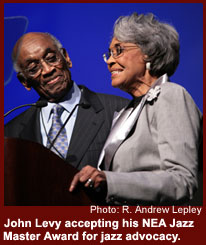
The program opened with two big band pieces played by The Jon Faddis Jazz Orchestra — “Beige,” from Duke Ellington’s suite, “Black, Brown & Beige” and a Frank Foster arrangement of John Coltrane’s “Countdown.” Then the first three of seven Jazz Master awards were presented to Freddie Hubbard, Ray Baretto, and Chick Corea. Each presentation was preceded by a short biographical video clip, and followed by a brief acceptance speech. Then the Count Basie Orchestra took the stage and was all-too-soon joined by vocalist Nnenna Freelon. After her third song it was back to the awards presentations.

The video segment on John, which included the obligatory childhood photo, also included some seldom seen footage of John playing bass with the original George Shearing Quintet, something most people in the room had never seen or heard before. Then it was time for Nancy to give John his award, the moment she’d been waiting for all night. I have seen her tear up before when talking about John, but this time it really got to her. She wanted to regale the audience with chapter and verse of John’s good deeds, but she couldn’t, and it was just as well because John wanted to get on with thanking some of the people who helped him in his long career. He thanked Bobby Tucker, George Shearing, Cannonball Adderley, Marty Klein, Laurie Goldstein, his son, George Wein, Darlene Chan, his in-laws (my parents), and me.

The last award given was to Tony Bennett, who, in his acceptance speech, thanked his son, the best manager he’s ever known…except for John Levy. I couldn’t see in the dark, but John might actually have blushed at that one.

The evening ended with a classic battle of the bands, playing the Frank Wess arrangement of Ellington’s “Battle Royale” and a Thad Jones piece titled “To You.” The finale was One O’Clock Jump, during which several Masters sat in (Jimmy Heath, Slide Hampton, Chick Corea, James Moody scat singing) and were upstaged by a ten-year old trumpet dynamo named Tyler.

When it was all over…we were hungry. There was no dinner served, just the luncheon and some hors d’oeuvres at the reception, so we went upstairs, changed into “street clothes” and headed for the Carnegie Deli where I had a bowl of matzo ball soup and we shared a hot pastrami sandwich. Can’t get that in Los Angeles (Jeri’s Deli and Cantor’s not withstanding). We didn’t linger, though, because Saturday’s schedule was just as busy. Stay tuned.

[Note: As you can see, the photo of John and Nancy posted here is not one of Leroy’s. I hope to have his pictures soon, and I know that between my blog, John’s website, and Leroy’s site, we’ll be posting quite a few. I’ll let you know when that happens.]
Radio Alert

Fabulous News!!! As I mentioned two days ago, John did an interview with Sara Fishko that aired in New York on WNYC as part of Sara’s series called Fishko Files. We just now received an email from Sara announcing

“the piece I did on John Levy has been picked up by the NPR program All Things Considered. It will run this Sunday on hundreds of radio stations all over the country. So – tune in! They think it’s going to run in the middle of the program, which in most places runs from 5 to 6 PM – but check your local station! ”

Click here to find the broadcast time and station in your area.

IAJE & NEA: The First Few Choruses

Thursday morning I spent two hours talking with Duane Grant, Luther Henderson’s step-son and right hand man for many years. It was time well spent, though I was sorry to miss out on hearing A.B. Spellman’s one-on-one with Billy Taylor. At least I got to spend some time with Dr T over coffee the next day, and to hear him play several days later in the studio, recording with Nancy. (He played a very beautiful solo on “I’ll Be Seeing You.”)

At 2 o’clock, John and I both went to the Jazz Lives In Print panel, moderated by Paul de Barros. We had lots of friends in the audience, including attorney Noel Silverman, producer George Avakian, Mr. Jazz Times a/k/a Ira Sabin with his wife, Irma, and photographer Stephanie Myers, who was kind enough to bring me a contact sheet with pix from an event involving Luther Henderson.

The blurb for the panel sounded interesting (as I mentioned in my January 4th post about biographies, here), but it’s hard to reach any real depth when you cram five panelists into one short hour and spend far too many precious minutes reciting their credentials. Their credits are impressive, but if I had been moderating I would have printed up a sheet of mini bios instead and let the attendees take it with them…hopefully to the bookstore.

Gary Giddins, who could easily conduct an invaluable biography workshop all on his own (is anybody listening – this would be great!), had some sound advice – “Never trust anybody. Everybody lies.” Perhaps stated in the extreme, but true. Not only do biases abound, but credence is often given undeservedly to those perceived to be experts or gurus. In the world of jazz, Leonard Feather comes to mind; I have seen a number of examples documented by researchers that show his pronouncements were inconsistent and often motivated by matters other than the music itself. Then there is the simple mistake that today is magnified thanks to the Internet. For example, the AP Wire ran a story about the Jazz Masters and one of the accompanying photos identified “Pianist John Levy…” [FYI, I wrote to the AP Entertainment Editor, saying in part, “I realize that this is not a huge error, perhaps even inconsequential, but given the wide reach of the AP Wire, and the permanence of digital information in these times, I would hope that the mis-information could be corrected so as to not proliferate inaccuracies in perpetuity.” I am happy to report that I received an immediate response: “Thanks for calling this to our attention. We actually ran a correction on Monday, Jan. 16.” I’m glad they did, but I’d be even happier if I were to see the correction run in the papers that actually ran the photo.]

Most jazz biographies are about performers — singers and instrumentalists. Not only are they usually more famous than, say, arrangers or recording engineers, but their work is something that the public understands. Some composers become famous enough to merit a biography (even a movie) – think Cole Porter, George & Ira Gershwin… — but not often does an arranger get the spotlight. Maybe that is changing, and when a comment was made about the relatively recent spate of biographies about arrangers and composers (including panelist Peter Levinson’s “September in the Rain : The Life of Nelson Riddle” and Stephanie Stein Crease’s “Gil Evans: Out of the Cool“), Mr. Rifftides kindly made mention of my work in progress – Seeking Harmony: The Life & Music of Luther Henderson. I have to admit that I have not yet read the Gil Evans bio, but I plan to do so very soon. There are apparently some similarities between the Evans and Henderson approach, including their penchant for borrowing from other musical genres, especially classical.

After the panel, we left quickly hoping to get in to see the DownBeat First-Person Interview with Sonny Rollins, moderated by Ira Gitler. Whatever were we thinking?! Sheraton’s New York Ballroom East was filled to overflowing long before it was time to start. We were but two among the hundreds of people who were turned away – no exaggeration.

Thursday evening we ventured off site and headed for Dizzy’s Club Coca Cola. It was our first time seeing the new Jazz at Lincoln Center digs in the new building on Columbus Circle. For those of us to whom “malls” are nothing new, this cornucopia of shops and offices and whatnot is not all that unusual, still it has that New York je ne sais quoi with a savvy, sophisticated, up-scale air about it. The club has the feel of a cosmopolitan movie set and it will not surprise me when I see it on the big screen (Woody Allen has probably made such plans already). The Lewis Nash Quartet, featuring Peter Washington on bass (one of John’s favorites), Renee Rosnes on piano, and Steve Nelson on vibes, was paying tribute to two jazz legends from Detroit – Tommy Flanagan and Milt Jackson. I had forgotten that Lewis and Peter played for ten years as members of Tommy’s Trio, which explained why they seemed to breathe as one, even though the ensemble as a whole was not as tight. The bass was consistently solid and steady, the drums always tasty, but the group, falling in and out of the pocket, was unable to sustain a groove.

That’s not to say they were bad – these are four musicians of the highest caliber – but there’s always room to be even better. There were beautiful moments, unusual unison riffs, and arrangements crafted with much forethought and love. Selections included a Bag’s favorite FSR (For Sonny Rollins), Arioso (a James Williams original), that drummer’s showcase of a tune, Caravan, and the set-closer, Bag’s Groove. Today’s Rifftides post says “Nash’s unaccompanied introduction to Flanagan’s “Eclypso,” using only his fingers and the palms of his hands across the drums, was electrifying.” I agree wholeheartedly, having heard Nash apply the same technique to the intro of Caravan. Lewis Nash is my favorite drummer, and “way high” on my list of all-around favorite people, period. Still I can’t help but wonder what the jazz scene would be like today if, instead of makeshift groups assembled from persons set on their own individual career paths, we had ensembles that played together for a long time to develop a group identity. And what if, like the good old days, gigs were to last for weeks, or even months? You remember — the kind of gigs that fostered a repeat audience who came in night after night and never heard the same thing twice.

IAJE & NEA: A 4-Bar Intro

Each year, the kick-off event to the IAJE conference is a Gala Dinner (black-ie optional). During the affair, the primary purpose of which is to thank the convention sponsors and major IAJE donors, awards are given, and a student ensemble (the Clifford Brown – Stan Getz Fellowship All-Stars) provides musical entertainment. Cocktails were followed by dinner in the Trianon Ballroom. John wore his tux and we were seated at the host table with Nancy Wilson, IAJE President’s Award honoree Clark Terry and his wife, Gwen, NEA Chairman Dana Gioia, and IAJE President David Caffey. Across the room I spotted George Wein and Jesse Jackson, the latter in town to eulogize Lou Rawls.

It’s all about seeing and being seen, and it’s often the only opportunity to see folks who are on hand for the convention but who you might not otherwise see because of conflicting schedules. For us, those hellos included composer and band leader Maria Schneider (an amazingly talented young lady who I had the privilege of managing for five years), Doc Severinsen, bassist John Clayton, and pianist Mike Wolff. Nancy introduced all the Jazz Masters past and present, getting predictably emotional when she spoke about John, who has not only been her manager but also the steadiest and most reliable force in her life for nearly fifty years, through ups and downs, births, deaths, and marriages. Two nights later at the NEA Concert and Award Ceremony she would say “John Levy is one of the most special men I have ever known in my life. I want to thank him for being my father. I want to thank him for being the man who made me.”

When Nancy introduced the five high school student all-stars she set the bar high, suggesting that they would have to be really good to hold their own with the Sisters in Jazz Collegiate All-Stars. Perhaps it was an unfair contest to pit high-school against college, but something worth striving for. Sad to say, in my not so humble opinion, this year’s young men were not up to the challenge – they had plenty of technique, but little else. The usual excuse given for such a weak ensemble performance is that the group had little if any opportunity to work together, but I don’t buy it. Jazz is not a solo sport, and it seems to me that young players today are either not taught to listen, or they are not interested in the art of listening – everyone was way too busy showing off their chops.

After a video segment featuring one of his inimitable performances of “Mumbles” – a hilarity that never fails to amuse and delight no matter how many times it’s been heard – Clark Terry walked onstage looking very dapper, right down to his blue patterned shoes. (Perhaps alligator?). He has received so many proclamations, citations, city keys, and hall-of-fame inductions, not to mention multiple honorary doctorates, three Grammy nominations, the French Medal of Honor, and a German knighthood, that the IAJE award might have seemed a small thing, but not to CT. He was truly moved, and so was the audience.

IAJE & NEA: Prelude

I don’t know what made me think that I could see everyone and do everything that I wanted to see and do while in New York City – wishful thinking, I guess. I really wanted to meet Just Muttering in person and I also hoped to stop by Local 802 to visit bassist Bill Crow. Both were high on my list of personal priorities, and they are now at the very top of the list for my March trip. I did manage to fit in two personal appointments — lunch alone with my parents, and lunch with my best girlfriend of 45+ years — after that, it was pretty much all business on multiple fronts.

John and I arrived in the Big Apple uneventfully on Sunday, early evening. After unpacking, we set out to find some dinner. On Seventh Avenue, between 54th and 55th Streets, a door or two south of the Carnegie Deli, is China Regency. This inexpensive Chinese restaurant has been there for more years than I can remember, and it was always a favorite of Joe Williams. John and I shared an order of shrimp in lobster sauce with fried rice, and that hit the spot.

My cell phone began ringing at 8 AM on Monday morning – still 5 AM to mind and body. It was Pam Koslow, producer of Jelly’s Last Jam and widow of the show’s Broadway star, Gregory Hines. “I can meet you tomorrow at 10 AM, she said, and so began my rescheduling. The Luther Henderson biography interviews that I had intended to do on Monday and Tuesday, before the convention began, got moved to Tuesday, Wednesday, and Thursday.

After meetings with the IAJE (International Association for Jazz Education) and NEA (National Endowment for the Arts) staff people to finalize details of John’s schedule, John and I were off to have tea with George and Ellie Shearing. Over a tasty fruit tart and cups of brewed tea, John and George reminisced. George’s short-term memory is not as vivid as his recollections of the past, but he still takes great delight in re-telling the stories of the original quintet and his escapades with John that began in 1949 and continued for any years. The road stories are always the best, including George, behind the wheel, driving across the desert in Nevada. Ellie told us that she and George attended a concert at the 92nd Street Y the week before, where Dick Hyman, Bill Charlap and others played several of George’s compositions. She also told us that George has been playing duets at home with Michael Feinstein and other musical cohorts who come to visit.

Tuesday morning I met with Pam Koslow who talked me through the trials and tribulations of producing a show for Broadway. The trip from idea inception to stage realization took ten years, but it was worth every nerve-pinching moment, even when she and co-producer Margo Lion had to put their apartments up for loan collateral. After checking in with John, I took off for downtown to have a late lunch with my parents while John prepped for his 4 pm interview with Sara Fishko of WNYC radio. (To listen, click here.)

By 6 pm we were ordering cocktails at Fontana Di Trevi, our favorite mid-town Italian restaurant, with long-time friend Laurie Goldstein who also happens to be the exec in charge of GOPAM, the music publishing company that John set up several decades ago to administer music publishing for his clients. This is one of John’s claims to fame, as it were. He believed that jazz musicians ought not to give away their publishing rights, so he set up individual publishing companies wholly owned by each artist/composer. We lingered over cappuccinos and by the time we returned to the hotel, Clairdee and Ken had just arrived from the airport and were checking in. We ended the night with them at the hotel bar.

At 9 o’clock on Wednesday morning I was knocking on Chico Hamilton’s door. Chico was the drummer with Lena Horne during the days when Luther Henderson was her musical director. For almost two hours Chico told me stories dating back to 1947 when Luther first hired him. He described the rehearsal scene at the house on Nichols Canyon Road where Lena and Lennie Hayton lived – the big gate and Luther, the “sharp dude” who came out in answer to the bell. He talked about rehearsing bar by bar, touring by train (Lena didn’t fly), and earning $125 week out of which he had to pay his own room and board.

As I was leaving Chico’s studio and walking over to Third Avenue, I returned a call to Duane Grant. Duane was not only Luther’s step-son, but also his musical assistant for many years and I wanted very much to spend some quality time talking to him. It was with Duane’s help that Luther was able to complete one of the most important events in Luther’s life, the Classic Ellington project. Luck was with me and we made a date to meet for two hours the next morning. As I headed uptown to the Candle Café to meet my girlfriend for lunch, John was live on WBGO radio with Rhonda Hamilton. (You can hear an excerpt here.)

John and I rendezvoused back at the hotel in time to suit up – both of us in tux – for the Gala kick-off dinner hosted for IAJE by none other than Miss Nancy Wilson.

Did You Miss Me?

For some reason that I cannot yet fathom, all of my laptop’s network connections have failed on me — the wired Ethernet jack, the wireless PCMCIA card and the wired PCMCIA — so I have been unable to get online to blog from New York. We’re still here in the Big Apple, flying home tomorrow, and I’m posting a quick note to you from Studio D in the Sony Recording Studios on West 54th Street in New York. It’s been a whirlwind week plus here, all very exciting and exhilarating. After a busy week of John doing interviews, signing autographs and becoming a National Endowment for the Arts Jazz Master (along with Ray Baretto, Tony Bennett, Bob Brookmeyer, Chick Corea, Buddy DeFranco, and Freddie Hubbard), we spent yesterday and today with Nancy Wilson and our friends from MCG Jazz as they finish up Nancy’s new recording. The CD, which will be titled Turn To Blue, features a number of guest soloists and today there are four Jazz Masters in the room at one time: Nancy, Jimmy Heath, Dr. Billy Taylor, and John (no, John is not playing). Regina Carter, who is down the hall mixing her latest recording, stopped by just in time for a sip of celebratory champagne. Looks like a wrap. I’ll be back online no later than Wednesday with a full report of our trip.