Jazz And The Poet Laureate is the title of Mr. Rifftides’ piece today. I happen to be in Toronto this weekend with two poets who, as jazz lovers, have put their passions not only on the page, but into action. As poets, each has written about and been inspired by jazz, but beyond their talents as poets, their love of jazz has led them to contribute greatly to the lifeblood of jazz and so I wish to call Dana Gioia and A.B. Spellman to your attention.
A February 2003 headline in the San Francisco Chronicle read: “Who Is Dana Gioia? He’s a poet, a businessman, a Northern Californian and President Bush’s choice to head the National Endowment for the Arts.” Now, in his second term as Chairman of the NEA, Dana continues to elevate jazz, expanding the Jazz Masters program in his quest to make it equal to the prestige of the pulitzer prize. (Our good friend Terry Teachout, as a member of he National Council on the Arts, is well acquainted with Chairman Gioia.) Dana is an award-winning poet, essayist, critic, and author, and his poems have been set to music by numerous composers, from classical to rock. I asked Dana about this and he mentioned Dave Brubeck as one of those composers and also spoke of a joint performance he did in New York with Chico Hamilton. On his web site you will find his bio along with many links to poems, and excerpts from his works and interviews.
I met A.B. a few years ago through the jazz masters program but I did not know a lot about his background. A little web research yielded the following:
For thirty years A.B. Spellman was “a guiding force in the continuation and expansion of the NEA Jazz Masters program” and the NEA Jazz Master award given for Jazz Advocacy is now given in his name. He is an author, poet, critic, and lecturer. He was a poet-in-residence at Morehouse College, in Atlanta, Ga. He taught various courses in African-American culture; offered courses in modern poetry, creative writing, and jazz at Emory, Rutgers, and Harvard Universities. Spellman is an occasional television and radio commentator. He offered reviews and commentaries on National Public Radio’s Jazz Riffs series, including the NPR Basic Jazz Record Library program. Mr. Spellman is a graduate of Howard University. read more
And from the History Makers website:
In 1966, Spellman’s writing career took off when he published his first full-length book, Four Lives in the Bee-Bop Business, an in-depth look at the lives of jazz musicians Cecil Taylor, Ornette Coleman, Herbie Nichols and Jackie McLean. The following year, Spellman joined a group of black poets touring the nation’s historically black colleges. From 1968 until 1969, he worked as a political essayist and poet for Rhythm Magazine, and in 1969, Spellman conducted a lecture series throughout the country teaching at various colleges including Morehouse, Emory and Rutgers. read more
Here’s a brief excerpt from A.B.’s poem titled After Vallejo
…when you come for me come singing
no dirge, but scat my eulogy in bebop
code. sing that i died among gods
but lived with no god & did not suffer
for it. find one true poem that i made
& sing it to my shade as it fades
into the wind. sing it presto, in 4/4 time
in the universal ghetto key of b flat…
And here on the NEA web site you will find links to audio of his reading of After Vallejo and his remarks to the National Council on the Arts in March 2005.
These two gentlemen are well worth knowing; they have done immeasurable good for the world of jazz and in support of jazz musicians in America.
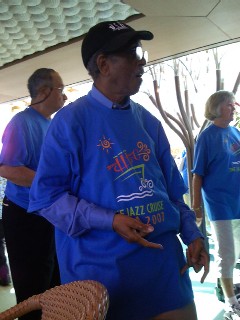 By noon it was a breezy 78-degrees with winds from the East-North-East at 22knots (25.3mph) and poolside was crowded with jazz cruisers (including Jimmy Heath, left) all wearing their blue cruise t-shirts that entitled them to free drinks. Pina Coladas in the sun made me miss the Keyboard Capers (a series of piano solos) but I did make it later to hear the first four tunes in
  After dinner we caught
  With
With 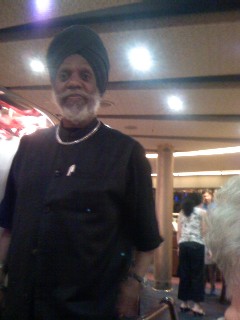 Organ master Dr. Lonnie Smith was up early too, and I had breakfast with him and a documentary filmmaker named Bill. Conversation ranged from whether or not we wanted to go ashore and peruse the
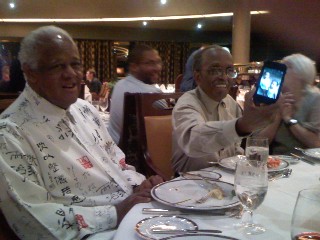 Following dinner, during which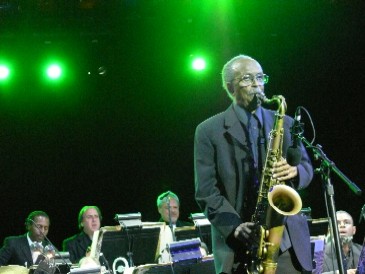
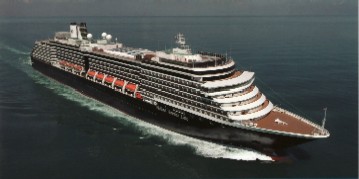 At 950 feet long and 106 feet wide, The Westerdam, built in 2004, is just slightly smaller than the Norway (a difference of less than 14,000 sq ft. or about 12%) – walk three times around the Westerdam promenade and you’ve traveled one mile. The ship has 11 decks, 14 elevators, lots of stairs, two swimming pools, bars, lounges, a casino, even an internet café. Our cabin was on Deck 5, the Verandah Deck half way between the mid and aft of the ship. It was compact, but we had a small couch and the floor-to-ceiling glass door to the private deck with two chairs made it feel spacious. As we waited for our luggage to appear, we explored our room in search of drawer space, which we finally discovered under the bed hidden by a dust ruffle.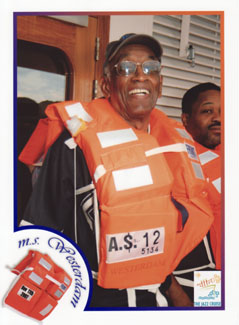
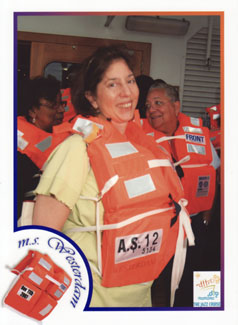 The first order of ship’s business was the mandatory lifeboat drill at 4 pm. I thought it would take longer for 1802 guests to be logged in as present and accounted for, but at exactly 4:56 the crew let go the lines and we were un-docked. Thirty minutes later the sea voyage officially commenced and Nassau lay 183 nautical miles (210.45 statute miles) away as we cruised off relatively slowly at 14.6 knots (or about 16.8 miles per hour).