What! The weekend is over?

Good morning. I’m having trouble getting my engines started this morning, or as Steven Wright once quipped, “I’m writing a book. I’ve got the page numbers done.” So I was trolling for inspiration and started with proverbs:

Vision without action is a daydream. Action without vision is a nightmare.
~ Japanese Proverb

Talk doesn’t cook rice
~ Chinese Proverb

The first step binds one to the second.
~ French Proverb

It is not enough to know how to ride. You must also know how to fall.
~ Mexican Proverb

Frankly the proverbs didn’t do the trick. So I turned to these guys who had some pretty straightforward advice:

Inspiration is wonderful when it happens, but the writer must develop an approach for the rest of the time… The wait is simply too long.
~ Leonard Bernstein

You can’t wait for inspiration. You have to go after it with a club.
~ Jack London

The great composer does not set to work because he is inspired, but becomes inspired because he is working. Beethoven, Wagner, Bach and Mozart settled down day after day to the job in hand with as much regularity as an accountant settles down each day to his figures. They didn’t waste time waiting for inspiration.
~ Ernest Newman

Well: time is short; waste not, want not; and all that jazz. I’ve got to get some work done and then I’ll be back with more postings.

Interview Process: Technicalities

Regular readers know that I’ve conducting a lot of interviews lately with people that knew Luther Henderson — nine interviews, totaling sixteen hours, in the past two weeks alone. I’ve met with Sheldon Epps, director of the Pasadena Playhouse and creator/director of Play On!; the wonderful golden gal, Bea Arthur, who Luther coached in her ingénue days; actress Armelia McQueen, who was in the original cast of Ain’t Misbehavin’; Luther’s daughter, Melanie; and composer/arranger Billy Goldenberg,who was a Broadway colleague of Luther’s is also a good friend of Bea Arthur and accompanist for her one-woman show. By phone I’ve talked with Liza Redfield, the first female conductor on Broadway; David Alan Bunn (mentioned here a few days ago); Polly Bergen, who, from the mid 1950s until Luther’s death in 2003, would not work as a singer without Luther as her musical conductor; and Susan Birkenhead, the lyricist/collaborator who, with George Wolfe and Luther, created Jelly’s Last Jam.

I know a few writers who have the ability to either take extremely comprehensive notes and/or retain everything they hear, including the best snatches of dialogue. I take notes, but I don’t feel so skilled, and I don’t need the pressure, so I record all of my interviews. For years I used to use a cassette recorder and rejoiced when they came out with a model that had auto-reverse, thus saving me from having to stop and turn over the tape. My euphoria evaporated on the day of a particularly long interview when I lost track of the time and auto-reverse kicked in for a second go round, recording over the first side of the interview. I didn’t even notice until I got home. A year or so ago, I asked Maria Schneider what she was using to record her audio notes and interviews for her ArtistShare website and she showed me her Sony mini disc recorder. I bought one, a Sony MZ-NH1. It’s small (3-inches square and half inch thick), lightweight (4.5 oz with a disc inside), each disc holds a few hours of audio (depending on speed) and the rechargeable batteries are long-lasting as well. Even better, the recording is digital and the sound quality is terrific. The microphone, which is only an inch long and the thickness of a pencil, picks up everything. For the telephone interviews, I use a Radio Shack gizmo (this one or that one) that connects the telephone to the mini disc microphone jack.

It’s the post-interview process that becomes a bit cumbersome. I want to save the interviews on compact discs so that they will last for a very long time (longer than audio tape) and take up very little physical space. Unfortunately, the mini disc recorder is not meant for uploading files to one’s computer, so in order to store the audio on my computer (and subsequently burn the files on CDs) I have to run a cable from the mini disc headphone jack to the microphone jack of my computer, launch my recording software, hit play on the mini disc and “capture” the sounds. Once the whole audio file is on my computer, I can save it in smaller pieces, making each a track to be stored on an audio CD. (I could save the files on a data CD, but then I would not be able to listen to them on a CD player.) Ironically, once I have burned the CD (I use the discs that hold 80 minutes of audio), I turn around a dub a 90-minute cassette tape that I send off to my transcriber – she likes her foot-pedal-driven cassette transcribing machine. (Radio Shack foot pedals don’t work with portable CD players or the mini disc player….Yes, I did try it.)

It might seem like it would be a waste of time, a triplication of effort, but I find it useful. I don’t listen avidly to an interview while it’s being copied to tape — I’m usually multi-tasking, reading articles, making appointments, following up on this or that — but I do hear it on some level, and snatches of it often grab my attention prompting me to jot down occasional thoughts as they occur to me. And, I might add, these are the kind of thoughts that seldom if ever come to me when summoned — flashes of insight, connections between seemingly disparate events or people, ideas for structure, shape, and transitions….answers to questions I otherwise might never have thought to ask.

Brick Fleagle

Born August 22, 1906, Brick Fleagle would have been 99 years old today. Before beginning research on Luther Henderson’s biography, I knew of Fleagle only as Luther’s friend and chief copyist. I didn’t know that he started out playing banjo, then switched to guitar and worked with trumpeter Rex Stewart. I didn’t know that he was also an arranger who penned charts for Stewart, Chick Webb, Jimmie Lunceford, Fletcher Henderson, and Duke Ellington. I haven’t yet documented when Luther and Fleagle first met. I have read that Fleagle did a lot of music copying for Ellington, but was that in the 1930s, the 1940s, or possible even later? Did Luther ever go to hear Fleagle’s group at the Arcadia Ballroom in the mid 30s? Did Fleagle hear about the kid who won an amatuer contest at The Apollo Theater in 1934? Fresh out of Julliard in 1944, Luther was working for Ellington — was Fleagle already on Duke’s payroll then? Did Luther hear the tracks arranged and recorded in 1945 by Fleagle and his Orchestra for H.R.S.? [These can be heard on Mosaic’s reissue of The Complete H.R.S. Sessions and include The Fried Piper, When The Mice Are Away, Double Doghouse, among others.] Did Luther read the July 30, 1945 review, “Brick’s Boys Go Riding,” in Time magazine? All I know so far is that Luther and Fleagle worked closely together for many years, and that when Fleagle died, he left his belongings to Luther, who, in turn, later donated the wonderful collection to The Peabody Institute. I expect to learn more about that later today when I interview David Alan Bunn who was a protege of Luther. Mr. Bunn, who is a conductor, composer, arranger, and pianist for Broadway, recordings, and television, is also the founder of the Jazz Studies Department for the Peabody Institute of Johns Hopkins University. Oh yeah, there’s also a great story about Luther visiting Fleagle in the hospital and bringing a voodoo woman with a live chicken for sacrifice…you’ll have to read the book when it comes out.

Why They Write

Thomas Wolfe from Of Time and the River:

“At that instant he saw, in one blaze of light, an image of unutterable conviction, the reason why the artist works and lives and has his being — the reward he seeks — the only reward he really cares about, without which there is nothing. It is to snare the spirits of mankind in nets of magic, to make his life prevail through his creation, to wreak the vision of his life, the rude and painful substance of his own experience, into the congruence of blazing and enchanted images that are themselves the core of life, the essential pattern whence all other things proceed, the kernel of eternity.”

Joseph Conrad in his famous preface to The Nigger of the ‘Narcissus’ (1897):

“My task which I am trying to achieve is, by the power of the written word to make you hear, to make you feel it is, before all, to make you see. That and no more, and it is everything.”

Attributed to Albert Camus:

“The purpose of a writer is to keep civilization from destroying itself.”

Lord Byron from Don Juan:

But words are things, and a small drop of ink,
Falling, like dew, upon a thought, produces
That which makes thousands, perhaps millions, think.
‘Tis strange, the shortest letter which man uses
Instead of speech, may form a lasting link
Of ages; to what straits old Time reduces
Frail man, when paper – even a rag like this – ,
Survives himself, his tomb, and all that’s his.

Why him?

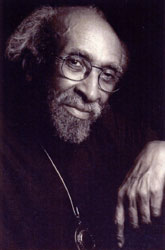
Luther Henderson is not a household name, not even a B-list celebrity in the eyes of the general public. Finding a publisher for his biography has been a lengthy and difficult process, but I am pleased to say that I have been offered a contract, am in negotiations right now, and hope to announce the signing very soon. Meanwhile, people are asking me “Luther who?” and “Why him?”

I was unaware of Luther’s accomplishments when I first met him. I do not remember how that first meeting came to be. He was close to many people who are, or were, important in my own life. Still, I don’t recall any one of them making the introduction. My earliest recollection is of a planning meeting in the mid-1970s for the annual Jackie Robinson fundraiser, “An Afternoon of Jazz,” held outdoors on the grounds of Robinson’s home in Connecticut. Someone had recommended me to assist jazz pianist Dr. Billy Taylor with booking the artists, and I was in Marion Logan’s living room with Rachael Robinson, Luther Henderson, Billie Allen, and a few others. I may have grown up as a liberal, supported Rev. Martin Luther King’s work, and taken part in the March on Washington, but back then, I was unaware that Mrs. Logan was married to Arthur Logan, Duke Ellington’s doctor, and that they were close to Martin Luther King and the Southern Christian Leadership Conference. I knew that Mrs. Robinson’s husband was a famous baseball player, but I did not know that it was he who broke the league’s color barrier. (Not being a sports fan, and not yet born when it happened, I guess that was understandable, but they really should have taught us about it in school.) There was no reason for me to know that Ms. Allen was an actress and stage director, or that Mr. Henderson had graduated from Julliard in 1942, but had he been properly credited on recordings, being a jazz fan, I might have known that he had written orchestrations for Duke Ellington. They didn’t seem to mind my ignorance; I was just a college kid there to do a job.

Over the following years, I would return on several occasions to the annual summer concert at the Robinsons’, no longer as naive booker, but as guest. One year I went with saxophonist Jerome Richardson, who I was dating at the time. Jerome and Luther were great friends, and Luther hired Jerome to work on his projects whenever possible. While living in New York City, I got to know Luther’s third wife, Margo, and we would occasionally shop together or have lunch at Cafe Des Artistes. I soon moved to California with Jerome, and we saw Luther on many occasions, most often during the productions of Ain’t Misbehavin’ in California and France when Jerome was in the band. After a lengthy run close to our home in Los Angeles, the show ran for six months in Paris, where I joined Jerome for a month that included Christmas and New Year’s Eve. Margo had died two years earlier, and Billie Allen flew to Paris to spend the holidays with Luther; just after New Year they announced their plans to marry.

By the time they married, Jerome and I had split up. The new man in my life was John Levy, later to become my husband. John’s client, jazz singer Joe Williams, introduced us, and both Joe and John were old and dear friends of Luther’s. I was to return again several times to the Robinsons’ with John and with Joe (by then I was Joe’s publicist), and there, while the crowd enjoyed the music outside, we would always steal a moment in the gracious Robinson living room to catch up on the latest Henderson news.

Distance makes it difficult to stay connected, and we lived on opposite coasts, but whenever John or I went to New York, or whenever Luther or Billie would come to Los Angeles, we would get together. I had been in New York to see Black and Blue when it opened on Broadway, and John and I both saw Jelly’s Last Jam, first in Los Angeles and later in New York. We knew that Luther was ill; we knew that he had cancer, but we thought he had beaten it. We would hear that Luther was very sick, and then we would talk to him and he’d tell us about a new project he was working on. This happened more than once. When the end finally came, we were blindsided, and unable to get to New York in time to see him. At least John was able to say a few words to him on the telephone during that last week when he was in hospice.

Later we learned that just a few weeks before Luther went into hospice care, Billie told him that he was to receive a National Endowment for the Arts Jazz Master Fellowship, an honor that pleased him greatly. She said that he responded with just one word: “Recognition.” He had little energy to say more, and died not long thereafter. John and I were not able to attend the New York memorial service, but we were there in 2004 when Billie Allen Henderson, accompanied onstage by Luther’s son, Luther Henderson III, and his daughter, Melanie Henderson, accepted the NEA Jazz Master Award in his memory.

As I watched the video montage of Luther’s life, I realized not only how little I really knew about this man and his legacy, but also how few of the three thousand people sitting around me in the immense ballroom of the Hilton hotel had even heard of him. I knew it was a situation I wanted to change.

Your Own Story

Awhile back, a young musical artist I know wanted to write a book about an older musical artist who had been an influence but who died before they really got to know one another. [I am not mentioning names, not to be coy, but because it’s not germane.] The young artist, wanting to know more, and also wanting to pay tribute, interviewed many of the older artist’s friends and colleagues, and then sent me a manuscript with a request for my opinion. To be completely honest, I was so profoundly disappointed by what I saw that, at first, I did not know what to say. Clearly the young artist had done a great deal of research and leg-work in contacting folks, interviewing them and transcribing their thoughts; also in compiling large portions of other people’s writings. And that was the problem. The manuscript was one large compendium of other peoples work and words and as such was little more than a copyright nightmare. I know a lot of people who are not Writers with a capital W, by which I mean that they are not writers by profession and/or they have not studied the craft, either formally or through years of practice. They are either hobbyists or professionals in another field who have a burning interest, message, and/or a story to tell, and they need guidance. Here’s the gist of what I told the young artist.

What is missing, first and foremost, is YOU. I know you wanted to tell the artist’s story in the artist’s words, but you can’t. Furthermore, readers want to go on a journey with the author — that’s you. You have a unique perspective from which to tell your story of the older artist and how the experience impacted your life. You probably think that you don’t have enough to say about that artist on your own, but I am not suggesting that you not use the research, rather that you make it part of the story of your journey to discover and get to really know the artist after death took away the person-to-person opportunities.

* There is your life before actually meeting the artist – when did you first hear the artist’s music? On record? Radio? Live? What did you think/how did you feel? Who was with you and/or with whom did you discuss it later? How did the artist’s work influence your musical and professional growth?

* Then one day you met the artist in person. How? When? Where?

* Describe the events where you were in contact and/or worked with or around the artist.

* The artist’s funeral

* Then, feeling the loss of the opportunity to learn more from the artist, you decided to get to know the artist by interviewing friends and colleagues, and by reading everything you could find.

Get into all these events and focus on that artist as seen through your eyes – what did you feel? What did you think? What did you learn? Try to remember what you thought/felt back then, and if time has given you a different perspective today, say so. If someone tells you about something that artist did or said, share your thoughts and reactions with the reader.

As an artist yourself, you think about things like the relationships between leader and sidemen, criteria for picking material, and such. You can explore these topics by sharing what you learned from the artist, from firsthand observation and from what interviewees said. The interviews should be woven throughout, but you have to use only the golden nuggets, then paraphrase any salient info, and lose the rest. Readers don’t want to wade through the transcripts; that’s your job. The golden nuggets are those that share insight and perspective, rather than obvious historical facts.

Writing is a craft, and, just like music, it takes training and practice. Of course there are many books on the market written by people who are not professional writers, but most of those ‘writers’ hire editors, book doctors, or ghost writers to help them create a publishable manuscript.

I still believe you have a story worthy of telling, but the materials you sent represent only the accumulated research. What you need now is to prepare a proper structure and to tell your story. The structure can be mostly chronological, and one way to find your story is to look at each little section you compiled and ask “what does that mean to me.”

Craft

“To get the right word in the right place is a rare achievement. To condense the diffused light of a page of thought into the luminous flash of a single sentence, is worthy to rank as a prize composition just by itself…Anybody can have ideas–the difficulty is to express them without squandering a quire of paper on an idea that ought to be reduced to one glittering paragraph.”
~~Mark Twain, in a Letter to Emeline Beach, 2/10/1868

Browsing Online

At Sketch For Nothing I found the fortune cookie that should have been mine yesterday.

At culturespace I found this post that I would describe as a prescription good for all that ails you.

At The Missouri Review, a web exclusive – On Reading Nonfiction by Michael Piafsky – where he quotes Samuel Johnson:

“the two most engaging powers of an author are to make something familiar new and to make something new familiar.”

Piafsky is partial to:

“a piece so skillfully crafted that despite its seeming mundanity, the author is able to bring to life for me something I’ve seen a million times but never quite looked at so closely, a piece whose writer could rivet me detailing an ant’s walk across my front yard.”

While Piafsky’s description could apply to fiction, here he is describing a genre called by many names, among them creative nonfiction or literary nonfiction. The University of Oregon, has online a good definition – What is Literary Nonfiction? – as well as a series of Q&As with some terrific writers including Ted Conover (Newjack), Melissa Fay Greene (Praying for Sheetrock) The New Yorker‘s Susan Orlean (The Orchid Thief), Alex Kotlowitz (There Are No Children Here, The Other Side of the River), Barbara Ehrenreich (Nickle and Dimed), to name a few.

Bea Arthur & Billy Goldenberg

I was working today on the list of people that I hope to interview for the Luther Henderson biography. It’s a diverse group of folks that includes singers and musicians, actors and actresses, choreographers and conductors, composers and arrangers, producers and directors, not to mention family, friends, and business associates. The variety among the females singers, alone — Barbra Streisand, Ruth Brown, Bea Arthur, Polly Bergan, Lena Horne, and Jessye Norman, to name just a few — attests to the ecclecticism and wide range of Luther’s talents.
Of the six ladies mentioned, I’ve met three: Ruth Brown is a friend, Lena Horne I encountered years ago during my days as a talent coordinator, and Bea Arthur attended the West Coast memorial for Luther in June of 2004. Last month I posted a description of the Canadian Brass’ appearance at the memorial. Here, then, is the excerpt about Bea Arthur and composer Billy Goldenberg:

Bea Arthur, accompanied by Billy Goldenberg, was on hand that Sunday to share some memories. As Billy got settled at the piano, Bea told us a story about her invitation to sing a song called It Amazes Me at an affair honoring Cy Coleman twenty-five years ago.

“I thought, ‘I know there’s going to be a lot of terrific talent honoring Cy,’ and I decided that rather than just slide in and go to rehearsal next day, I thought, ‘No. I’m going to go a day earlier and work with Luther and really kill the people.”

We had no idea how the story would end, but already we were laughing.

“So I did, and we worked; we worked all that day. Quite wonderful. And then the night of the event, which was, I remember, at Peacock Alley at the Waldorf – black tie, oh, I mean it was fabulous – a number of people got up and performed Cy’s stuff. And then Tony Bennett came and started singing and, of course, he leveled the place, just tore the place up to such a degree that – I don’t know if you remember this, Billy – that he had to do an encore. So Cy sat down at the piano and Tony sang…It Amazes Me. I never in my life … I was so devastated! So after that, we just went to the bar and got loaded.”

We, too, were ready to go to the bar and get loaded, but we quieted down as Bea, casually dressed in white pants, tunic top, and sandals, regal as ever, began to sing. Even without a microphone, her voice was strong and sure, her delivery, striking. She gave us two songs, It Amazes Me, and Don’t Miss the Chance to Sing, composed by Billy with lyrics by Tom Jones. I didn’t learn until later that while I’ve been at home watching twenty-year-old reruns of The Golden Girls, Bea has been on the road with her one-woman musical show And Then There’s Bea, later renamed Bea Arthur On Broadway.

Billy Goldenberg had a story too. It was 1964, Billy was in his twenties, and had been hired to do the rehearsal piano and dance music for a show called High Spirits with Tammy Grimes and Beatrice Lillie, directed by Noel Coward. Hugh Martin, the show’s composer, asked Billy if he’d like to write the overture. Billy was ecstatic, and petrified. It was Luther, a man had had never met before, who came to his rescue by helping him to orchestrate the overture.

“Luther came in and he looked at this sketch and he said, ‘This is really interesting.’ ‘Is it really, Luther? You’re the best. If you can do it, make it sound good.’ I said, ‘You know, I’ve done my best here, but I can’t really orchestrate.’ He said, ‘What do you mean, you can’t orchestrate?’ He said, ‘You’ve already done it here.’ He said, ‘I’ll add a few things and see if you like it.’ I said, ‘See if I like it!’ I said, ‘What does that matter?’ I said, ‘You do your genius thing,’ you know. Anyway, he did it, and well, everybody, the whole cast, they all stood up and clapped after the first orchestra rehearsal. And Luther came over to me and he said, ‘Next time you’re going to do it.’ And I did. And from then on, I did all my own things: stage, and then television and movies, and all of it. But it was Luther who said to me, ‘You can do it.’ That’s all he had to say. For someone who was so important to me, really to say that, changed my life. It really did. I’ll always remember him for that. Thank you, Luther.”

Luther who?

Luther Henderson is not a household name, not even a B-list celebrity in the eyes of the general public. Finding a publisher for his biography has been a lengthy and difficult process, but I am pleased to say that I am in negotiations right now and hope to announce a signing very soon. Meanwhile, people are asking me “Luther who?”

Luther Henderson was a composer, arranger, conductor, musical director, orchestrator, and pianist. He was a proud black man who graduated from the Julliard School of Music in 1942, and in 1956, married a white woman, his second wife. He was Duke Ellington’s “classical arm,” orchestrating music for Beggar’s Holiday, Three Black Kings, and other symphonic works. Duke spoke highly of Luther, but seldom gave him the credit he was due. Luther was Lena Horne’s pianist and musical director. During his sixty-year career in music, he worked his magic on some of Broadway’s greatest musical hits, including Flower Drum Song, Funny Girl, No No Nanette, Purlie, Ain’t Misbehavin’, and Jelly’s Last Jam, starring such performers as Barbra Streisand, Laine Kazan, Robert Guillaume, Savion Glover, Andre Deshields, Tonya Pinkins, and Gregory Hines. His music was heard on television programs such as The Ed Sullivan Show, The Bell Telephone Hour, and specials for the pop stars of the day including Dean Martin, Carol Burnett, Andy Williams, Victor Borge, and Polly Bergen.

Despite the success of these shows, on both stage and television, his contributions were never properly valued. What reason, or combination of reasons, led to this oversight? Certainly there were those who usurped credit, whether due to ego, carelessness, or resentment of Luther’s training and talent. Was he caught between two worlds – the elite classical world embodied in his Julliard training, and the world of jazz, his own heritage? Both worlds viewed him with suspicion; neither took him seriously. Was it due to the racial biases of the times? Or was it just the inevitable fate of a background man?

Those in the business understood his talent, but it is hard to communicate to an audience just what Luther really did. We value a composer above an arranger or orchestrator, thinking that one is more original and creative than the other. When music is described as ‘incidental,’ the word used for background music as opposed to featured songs in a show, we assume it is, well, incidental, not very important. Even ‘background’ conveys lack of importance. Most of Luther’s major projects were based on songs written by others, but the difference between a song in its original form and Luther’s orchestration based on that song is vast. Luther’s interpretation is every bit as creative as the original song. He tried to explain it in an interview for American Theatre magazine in 1997:

Sometimes I call it ‘translating’ the music, but it’s more like transporting the music. It’s going through me, and I’m enjoying it going through me, and I’m adding to it what happens when it passes through me. I don’t try to imitate Duke Ellington. I can’t copy Jelly Roll Morton. I can’t be Fats Waller. But I can express what Fats Waller, Jelly Roll Morton, and Duke Ellington mean to me. I can be the conduit.

Luther lived his life largely in the shadows, yet he never saw it that way. He was an affable man who appeared to view his experiences through proverbial rose-colored glasses, and for the most part, that is truly how he saw things. He lived as though he had plenty of money, but he was poorly compensated and he never liked to ask for proper recompense. He believed his work was important, but he said he enjoyed it so much, that it didn’t seem right to be paid. He thought everyone loved him – and most people did, but some didn’t. Growing up black in America, embracing both jazz and classical music – one, an American art form that has yet to be fully appreciated, and the other, a field not truly open to blacks at that time – was not a path to fame and fortune. But with a love of music, a prodigious talent, and an optimistic outlook, that is the life he chose. It was a life that required extreme dedication and concentration, sometimes to the detriment of family relations and his role as husband and father.