
Reminder From the East

My friend Bill Kirchner (radio broadcaster, jazz educator, great guy) wrote to me asking about a press release he read saying that John would bve speaking in New York tomorrow. It’s true and somehow I forgot to tell you all about it. Here’s the press release issued by the the Tribeca Performing Arts Center via Eigo’s jazz news service:

Lost Jazz Shrines Celebrates Café Bohemia

Tribeca Performing Arts Center’s annual “Lost Jazz Shrines” series – a celebration, remembrance and examination of some of the more significant and historic defunct jazz venues in downtown Manhattan – will focus on Café Bohemia.

Located in Greenwich Village at 15 Barrow Street, Café Bohemia featured such great jazz stars of the 1950’s as Miles Davis, John Coltrane, the Adderley Brothers and Charles Mingus. A number of classic jazz albums were recorded live at the club, such as
“Art Blakey: Live at Café Bohemia”, among many others.

Our concerts will honor and illuminate the music of Julian “Cannonball” Adderley, Jimmy Smith and Oscar Pettiford.
Concerts are held every other Friday with Humanities Program and Photo Exhibit.

May 12, 2006:
Humanities Program @ 7pm:
Willard Jenkins interviews NEA Jazz Master and industry giant John Levy. FREE ADMISSION.
Jazz Concert @ 8:30pm:
The concert features Louis Hayes’ Cannonball Legacy Band, celebrating the music of the great Julian “Cannonball” Adderley.
CONCERT TICKETS $25.

May 26, 2006:
Humanities Program @ 7pm:
Arnold J. Smith interviews 3 musicians who performed at Café Bohemia, Dick Katz, Bill Crow and Junior Mance. FREE ADMISSION.
Jazz Concert @ 8:30pm:
The concert features Hammond B-3 Organ Master Dr. Lonnie Smith with Special Guest Organist Reuben Wilson, honoring the music of NEA Jazz Master Jimmy Smith.
CONCERT TICKETS $25.

June 9, 2006:
Jazz Concert @ 7pm:
The concert features an All-Star band, performing the music of Café Bohemia’s Original Music Director, the legendary Bassist-Composer Oscar Pettiford. The band includes Eric Gould (Piano/Music Director), Sean Jones (Trumpet), Antonio Hart (Alto Sax), Don Braden (Tenor Sax), Robin Eubanks (Trombone), Leon Lee Dorsey (Bass) and Vincent Ector (Drums). With special guest Ron Carter.

CONCERT TICKETS $25.
Lost Jazz Shrines Celebration Awards Program @ 9pm:
The evening’s program, which includes a dinner held at Tribeca Grill, will honor Art Blakey, John Levy and Ron Carter for their long lasting contributions to the jazz world and to Café Bohemia.

For tickets to the awards program or for more information, contact Gabriela Poler-Buzali at (212) 220-1459 or email gpoler@tribecapac.org.

We’re not sure yet whether we will be going back again for the awards program, but we sure will be there tomorrow.

Gotta catch a plane. Hope to post some more from New York.
What Shall We Reap?

My friend over at Yarns & Yarns is Just Muttering about me again.

“Devradowrite attributes the problem to journalists’ inexperience and youth. I don’t think that’s it, unless one assumes all inexperienced and/or young people are irresponsible and lazy because I think irresponsibility and laziness are the core problems.”

Sorry to say that my cynicism runs much deeper than that. I don’t think that the majority of today’s youth are lazy, not at all. They work very hard at what they deem to be important. Nor would I describe them as irresponsible; they follow through on their agendas. What I do question are their values (or lack of) and their self-centeredness, traits that our society has encouraged down the wrong path.

With each passing year it seems that the degree to which the marketplace panders to youth grows exponentially; no wonder they think the world revolves around them. I do remember feeling in my twenties that I knew it all, so to some degree maybe nothing is new, but this is different. Feeling cocky or sure of myself was still a long way from disrespecting my elders, even if our slogan was “never trust anyone over thirty.” Dismissing or disregarding everything outside your own world view is disrespectful.

And what lessons do we teach when we hire packagers to help us with our applications and resumes, and when plagiarism and lies become the surefire way to increase your revenues.

A recent article in New York Magazine makes my point, so I am not alone with these thoughts. In Generation Xerox — Youth may not be an excuse for plagiarism. But it is an explanation. Kurt Andersen writes about Kaavya Viswanathan, “author” of How Opal Mehta Got Kissed, Got Wild, and Got a Life:

She is a flagrant example of the hard-charging freaks that our culture grooms and prods so many of its best and brightest children to become, a case study in one sociopathology of the adolescent overclass….

…she had already come to understand that her success so far was not just a matter of talent and discipline but of buying the right connections, cutting deals for behind-the-scenes assistance, cunning. She was hooked up with her packager, Alloy Entertainment, by the agency William Morris (which also represents me), and hooked up with William Morris by her college-application consultant, Katherine Cohen.

Cohen may be worth the $33,000 she charges for her “platinum package.” But there’s something fundamentally untoward about the cynical lessons that such a makeover process teaches the kids who go through it—especially when it seems to work.

I am afraid that as a society we are sowing a lot of bad seeds.

The Silver Lining

Figurative storm clouds broke overhead when last night a Google Alert linked me to web site where I found posted a copy of the Pasadena Star News article about John. Regular DevraDoWrite readers know that I was disturbed by the errors in this piece (if you didn’t know, read this), so you can imagine that I was none too happy about seeing it proliferate on the Internet. I sent off an email that began with “Much as we enjoy getting press coverage, the article by Ivy Dai, written for The Pasadena Star News/U-Entertainment, contains numerous factual errors and John and I would appreciate it if you would remove it from your web site.” [By the way, in the interest of acuracy, the piece was written for the Celebrations section, not U-Entertainment as cited by the post in question.] Within a couple of hours I received a reply thanking me for making him aware and apologizing for any unintended harm. As I had suspected, this was someone who had wanted only to assist by spreading news that he felt should get more attention, and for that I am very appreciative.

As I told our helpful blogger in a later email:

Sadly, today, The Media does not invest the care it should. Where once we might have been safe in assuming the veracity of items in a newspaper, that is no longer the case. Ivy was not only careless with the facts, she had no understanding of the story and instead tried to paint a personal portrait, one that became increasingly distorted because John would not participate, telling her repeatedly that this or that detail about his personal life was not relevant. She was determined to continue that line of questioning, so John started saying “I don’t remember.” You might think that at 94 John would be forgetful, but with the exception of a few names and dates, John is still very sharp (and he knows very well who gave him his Aires pendant).

As a nonfiction writer, this is one of my pet peeves. I feel rather like an old fogey (I’m 50, not 39) when I blame it, in part, on the youth of today’s workforce; there are fewer older/experienced workers, and those that are there and willing to mentor are marginalized, if not actually disrespected. I guess this is true in all fields.

If this had not happened, I might not have discovered TheJazzCat a/k/a LeRoy Downs online — jazz radio afficiando’s know LeRoy’s on-air work — and that is the silver lining. I spent some time this morning perusing LeRoy’s blog archives, and his enthusiasm and love of the music is palpable. For an example check out his post about his trip to NYC for IAJE — he loved Maria Schneider’s band and took lots of photos, posting one of Maria, Sonny Rollins and Ravi Coltrane. If you want to know about LeRoy the man, check out his web site. LeRoy is out there supporting music that I love and will be checking out his blog regularly.

PS: If you want to re-read my piece about Maria’s Disney Hall concert this past February, go here . My pieces about IAJE are 1, 2, 3, 4, and 5.

Today’s Discoveries

No doubt you’ve noticed that bloggers like to post the occasional quotations – given Internet access there is no shortage of pithy sayings that we can share with you. I will admit that, to some degree, the act of trolling for quotes is sometimes a combination of laziness and procrastination, but there is also a delight in finding an admirable turn of phrase, encountering a new metaphor, or discovering that a thought was put forth by someone you would not have imagined. Also fun, of course, is the juxtaposition of two or more quotes, be they compatible or antithetical. But what I like best about quotations and the power of the Internet is that I come across people heretofore unknown to me, and within a few keystrokes I can find out who they are or were, what they do or have done, and serendipitously broaden my horizons. Take these quotes for example:

“He who sings, scares away his woes” – Miguel de Cervantes Saavedra

“Music is the medicine of the mind” – John A. Logan

Why waste money on psychotherapy when you can listen to the B Minor Mass? – Michael Torke

I had jotted down these quotes some time ago. I knew who Cervantes was (the Spanish author), but until I did a little research I did not know that the quotation in question comes from chapter 22 of Don Quixote of la Mancha (translated by John Ormsby). I also found that the wording is sometimes given as “He who sings frightens away his ills.”

As for the other two men quoted, I had no idea at all who they were. Turns out that Logan was a politician who lived in the 1800s. He was a congressman, a brigadier general during the Civil War, later a senator, and Memorial Day was presumably his idea. (To read the congressional bio blurb go here.) Who would expect a switch-hitting politician (first a Democrat, later a Republican) and a lawyer to boot, to say that about music?

The third quote turns out to be from a music man, a composer. BrainyEnclopedia says he writes “accessible music influenced by jazz and minimalism” and that he is “sometimes described as a post-minimalist.” Not knowing what that means, I went to his website to listen to some clips. I don’t consider myself qualified to review or critique symphonic music, but I can tell you that it was pleasing to my ears. A cursory look at the critical acclaim he has received from those in the know supports my appreciation, but part of my enjoyment might also be due to the sound being a welcome change of pace from the music that I have been listening lately – not better or worse, just different. The only symphonic music to reach my ears in recent months is Luther Henderson’s Classic Ellington, recorded in England with Sir Simon Rattle conducting The City of Birmingham Symphony. The orchestrations are wonderful, but the experience of listening to orchestrations of songs with which I am very familiar is vastly different than listening to an original work for the first time, the latter allowing for a mental release that is not possible when the mind is filled with specific expectations. I never thought about this before today, and therein lies yet another benefit of cruising the Internet and letting one’s mind wander a bit. It seems that generating new ideas first requires letting go.

—-
ps – for those of you who know there to be a psychotherapist in my family, let me go on record saying that while music may soothe today, it is no match for the long-term benefits of analysis.

Compatible Quotes: Call To Action

Charles de Gaulle, War Memoirs, 1960:

“Deliberation is a function of the many; action is the function of one.”

Attributed to Will Rogers:

“Even if you’re on the right track, you’ll get run over if you just sit there.”

And there is always:

“Don’t just sit there, do something.”

This last one is such a common admonition that I can’t find out who coined it. Any thoughts?

Now What?

Thanks, everyone, for all the celebratory greetings and well-wishes on my first anniversary as a blogess/blogette, and special thanks to Mr. Rifftides for doing so publically on his blog — if you are a new visitor sent via Rifftides, welcome. I hope you’ll become a frequent visitor. And if you are one of my regulars and have never been to Rifftides, shame on you and go there now. Today Mr. Rifftides has taken on the not-so-Jazz Fest.

Well April, which was Jazz Appreciation Month (JAM), is over, but never over is our love for jazz. My love of jazz, however, has its limits, or rather some definition. I do not include in my embrace anything that smacks of smooth jazz or programs that purport to be jazz while pandering to the lowest common denominator

Sadly, Ramsey Lewis’ television series on PBS falls into both of these categories. According to one of the show’s musical guests, Ben Ratliff’s April 4th review in The New York Times “nailed it.” Ratliff describes the interview questions as “doggedly polite, basic and weirdly resistant to subtlety and insight,” reminds us, parenthetically, that “(Jazz is so cerebral, you know. It scares people.)”, and concludes with this:

In all its mainstreaming and common-denominator sense, the show seems to want to deny that jazz issomething people care deeply about. But jazz is deep. It is about sound and resonance and great passion. There is a reason people become nearly religious about it. You’d hardly know from watching this.

One of the more unusual JAM activities that caught my attention last month was news of a Tavis Smiley radio special to be taped before a live audience at Smithsonian Institution in DC on April 7th. Tavis said he was going to “lead a discussion with jazz artists, scholars and historians about the birth, evolution, support and survival of jazz in America and around the globe.” I haven’t heard it broadcast yet nor have I found mention of it on his web site. If I hear more about it I will let you know.

On April 12th I barely caught the end of a piece on PBS’ NewsHour program and it had something to do with jazz — I think it was an interview with someone from the Smithsonian; …ah, Jazz Appreciation Month, I thought. Unfortunately, the online archives for NewsHour yield no mention, so I can tell you no more and only hope that it wasn’t a figment of my imagination.

I’ll leave you today wih something you can hear for yourself. Over at the ITConversations website you can listen to (or download a podcast) titled The Future of Jazz. It’s a talk by Marty Ashby who, having produced numerous concerts and GRAMMY®-winning albums, as well as being an accomplished musician himself, has a lifetime of experience to share. He sits down to reflect on his past and to offer some insight on the future of jazz, both as a business model and as a vital art form.

May Day or Mayday II

I launched DevraDoWrite one year ago today, so happy anniversay to me.

On that day I learned a little about the derrivation of “mayday” as a cry for help as well as the history of May Day. May 1, 1886, American workers gathered to demand a more reasonable eight-hour workday, and today, 120 years later, immigrant workers are gathering and marching for what they perceive to be their rights. I say “perceive” because there is much disagreement even among “supporters.” Even I disagree with myself on some parts of this. I believe that if you want to live here and work here then you should learn the language and obey the laws. I do not believe that my money should be spent on creating a bi-lingual alternative to everything from classrooms to voting instructions. I think immigrants should enter the country legally and pay taxes like everyone else.

Of course, here the issues get murky and I suspect that it’s American business greed and politics that is at the root. First of all, it is admittedly hard to keep a straight face while writing “pay taxes like everyone else” when I well know that the rich get richer by leaping through those great big tax loopoholes designed just for them. Second, and perhaps more important, there must be a reason why immigrants risk life and limb to get here illegally; if the legal alternative was feasible don’t you think they’d prefer it? Why would someone stow away or dodge bullets while hopping a fence? Desparation implies no alternatives. And why is it so hard to get in legally? I can only surmise that it suits the employers to have leverage over their illegal workers, forcing them to work for less and without benefits.

Here’s an excerpt from “Illegal workers: good for U.S. economy,” an article on CNNMoney.com

A crackdown in illegal immigration in 2004 caused a shortage of workers needed to bring in the lettuce crop in the Western United States, said Powell, which he said caused a $1 billion loss for the industry as many growers had to leave their fields unharvested.

“To hire Americans to do it, they would have had to raise wages so far, it wouldn’t have been worth it for them,” said Powell at the Independent Institute. “It caused less of a loss to leave the crop to rot.”

As for complaints that many critics of immigration cite – demand for social and government services by immigrants – most economists believe that is outweighed by the increased economic activity, even if some specific school districts or public hospitals struggle with the costs associated serving the immigrant community.

So today the immigrants cry out for help as they celebrate May Day with their own demands. If they want to do as we do here, in English, them we must do unto them as we would have others do unto us.

“Hi ho, Silver, away!”

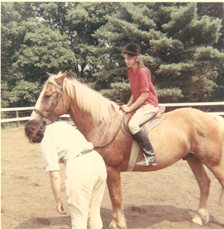
I was three or four years old when I first met a horse. My mother and I were living out West and because she took me almost everywhere with her, I got to go riding at an early age. I won’t claim to have a vivid memory of this, but I feel like I remember it. I have some other very clear memories of that time in my life, clearest being the floor plan of our house in the cul-de-sac. I remember going to the hospital emergency room when I punctured my ear drum, swallowing a quarter, digging for worms, twirling a baton (or trying to), playing with a lamb (a real live one), eating a dog’s Milk Bone, and riding in a jeep. And I remember the picture on the wall over my bed. But my memory of riding a horse is hazy, just a feeling, perhaps from photos I’ve seen long ago, perhaps not. Still, it must have been a good experience because seven or eight years later I became a pretty good rider, albeit back on the East Coast and in an English saddle. The photo at left is yours truly at summer camp, age 11.

I was fairly fearless as a young horsewoman, not afraid to ride bareback (emergency dismount was easy), and eager to participate in the local shows at which I won an occasional ribbon. I also remember a horse we named Camel because he liked to lie down and roll in the sand dunes at the end of one of the trails. I recall a few spills but I always got right back on the horse who threw me. Now, more than a few decades later, I have a fear of falling, a sensation that I do not recall feeling back then. But I still love to ride.

It’s been more than ten years since I have ridden. The last time was in Oregon, on vacation with my girlfriend, Alice. We had flown to Portland, rented a car and driven many hours down along the Columbia Gorge. Our plan was to slowly wend our way back toward Portland, stopping to spend a day in each town along the way. One day Alice said she wanted to go riding and she found a place listed in the telephone book. We called and booked a half-day trail excursion for the next afternoon. It was absolutely beautiful, but oh boy, we paid for it, and I don’t mean in cash. The following day we could do little more than sit by the pool at the Motel 6; any and all movement was painful. But it was worth it!

So here I am, at it again; the picture on the right is from yesterday. I’ve been going once a week and this is my third time. The first time the trainer put me on Contessa. She’s an older horse, stubborn but not wicked like some of the 3 year olds. We stayed in the arena that day and Contessa ran the show; I was just happy to stay seated. Last week, a friend went out with us and they convinced me that I could handle Flicka. I was doing fine in the arena, but then my friend talked me into going out on the trail. Wow. Or more appropriately, Whoa. First of all, to get from the stable to the arena you have to ride down the street with an occasional car passing by. The horses seem used to the cars, but lawnmowers spook them. The arena is in a large park, but to get to the trail you have the leave the park and ride down Lincoln Avenue, a fairly major street. At times, we rode on the sidewalk. The only thing missing were the hitching posts. Given the price of gas right now, perhaps not a bad idea. It was an exhilarating trip, even if half of the exhilaration was just plain terror. I acquitted myself well, and had some measure of control over Flicka, though I suspect only as much as she allowed me. This time it was back to Contessa and I stayed in the arena. We battled a bit, but I felt more in control. I went out in flat shoes because last week my ankle gave out and it may have been due to the heels on the boots I was wearing (I haven’t worn shoes with heels in more than six years). This felt a little better, so perhaps I’ll treat myself to some boots without heels. We’ll see. Gotta keep those heels down.

Visiting Colleagues

Mr. Rifftides has riffed on my rant from the beginning of this week. He is more dispassionate in a personal context, but passionate about the subject of journalism. Go here to read his thoughts.

There’s nothing more fun than discourse, whether in person or from afar, direct or indirect. Sometimes I tire of listening and prefer to just write, alone with my thoughts, but eventually I need the stimulation of interaction. Today, in visiting Terry Teachout’s blog I find a letter from one of his readers and his response. Their subject is how to appropriately subtitle a biography; should it be “A Life of so-and-so,” or “The Life of so-and-so.” We titled the video documentary of my dad “Jim Hall: A Life in Progress” so you might think I agree with with TT’s correspondent, but “the life in progress” clearly would not have been correct, it would have to have been “His Life In Progress,” but that sounds, quite frankly, rather boring. The logic, understood by both the correspondent and TT is that “the” makes it sound definitive while, in fact, TT’s work as well as dad’s video do not pretend to be exhaustive biographies covering every facet of the life in question.

What makes someone buy one biography instead of another? For me, it is my curiosity about that particular author’s perspective, his or her version of someone’s life as different from someone else’s, and what that life looks like at a particular moment in time — if the person is alive, where they are in the trajectory of their path, and if deceased then what the past looks like from today’s perspective. So yes, people do have many lives, not only as perceived by someone else but as perceived by oneself and other over time.

I hadn’t given this quandry any thought when I suggested that my Luther Henderson book (“a” work in progress) be titled “Seeking Harmony: The Life and Music of Luther Henderson.” Does that imply to you that it is a definitive, exhaustive, soup-to-nuts, heavy-weight tome? If so, I will need a new title. Or, if one believes that the writer can distill the essence of a person, then perhaps “the” is still correct; after all, we are not claiming “the one and only life of” whomever. Still it would only be my perspective of his essence.

But of course it is my perspective, I am the author. I know that and you readers know that. That is why our English teachers, and editors, told us to delete the words “I think” from our pieces. You know it is what I think because my name is on it. If someone else thought or said or wrote it I would have told you so — and if I didn’t, well that’s plaigerism and another story all together.

Missing In Action

Action being the operative word, it was a very busy week and included my second foray on horseback (more about that next week) and fending off a gazillion phone calls asking if it is true that John and I got together when I was 11 years old — ha ha — no, it is not true.

What could have been a lovely feature story in Friday’s Pasadena Star News was, sadly, full of factual errors, and worse, it was woefully short on substance. Errors included my age — I am 50 years old, 44 years younger than John, not 55 years younger than John which would make me 39 (and no, I don’t wish it were so); and we won’t even mention that there is no jazz musician I know of named Jim Hail. Okay those are two errors that are personal to me and I’m feeling snarky, but there are many others errors and a few misquotes as well. Whether due to shoddy/sloppy journalism practices or lack of experience I can’t say for a fact, but I do have an opinion.

Even though the reporter did request (and receive) a free copy of “Men, Women and Girl Singers,” John’s life story written entirely by yours truly (as John himself told her), I guess she didn’t have time to read it or any of the materials on the web site. However, she did interview John for two hours, consulted twice at length with his publicist, even called me with questions, and there is so much she could have written about.

Yes, he was the first African-American manager of jazz artists, but more importantly he was the first to encourage musicians to retain the publishing rights to their own compositions and he went so far as to set up the publishing companies that were fully owned by his clients. When gigs were not abundant, he produced his own shows at venues such as the Apollo, featuring his clients. He even produced records for his clients. He was a forerunner in his field. His years of success in all of these areas earned him an impeccable reputation in the entertainment industry, where he is both respected and admired by other managers, booking agents, concert promoters, entertainment lawyers and accountants, record company executives, and last but not least, the artists themselves. There a million people from whom she could have gotten a quick quote. He has been a role model for many in the business because of his integrity, business acumen and his unselfish dedication to the world of jazz, and that is why he was given the NEA Jazz Master Award, not because he happened to be the first Black manager in the jazz/pop field.

So what did she write about? She mentions his jewelry (how can someone describe a sapphire pinky ring, plain gold wedding band and zodiac pendant as “bling”), talks about his being home in Brooklyn for only 3 or 4 months out of each year and implies that it caused three divorces (he traveled a lot for a few years between 1949 and 1953 and it had nothing to do with any of his divorces, all of which came later), says he used to smoke but doesn’t anymore and has a drink every so often (is this important?) and can walk for several hours at a time (not true unless you count window shopping in New York City once every couple of years), claims he doesn’t have any aches or pains from old age (maybe in his dreams — she wasn’t paying attention)…need I continue?

Longtime DevraDoWrite readers know that I look up to writers such as Walt Harrington, Gay Talese, and Truman Capote, journalists who bring people to life by using what Harrington calls “intimate details,” but such details should not be gratuitous and must do more than suggest that the writer was there to see them, they are supposed to reveal character within the context of the story being told. (When teaching writing workshops I always use these stellar examples of detail in description.)

They ran a very lovely and extremely large photo of John — too bad they didn’t use some of that space to educate their readers with more substance.

So now that I’ve vented, and hopefully in the process corrected a few facts, do you want to know what else kept me busy this past week? Two pilates workouts with my trainer, two interviews for the Luther Henderson biography, two long distance phone conferences with six people dialing in for each, lunch with a girlfriend at a wonderful dumpling house in Arcadia, coffee with my publicist at my favorite neighborhood bakery, a visit from the Sears repairman, and oh yes, a glorious two and a half hours atop a horse named Flicka, riding down the streets of Altadena and onto the trail that surrounds JPL (Jet Propulsion Lab.) I plan to write more about horses and other things later in the week.
———————————-
Addendum: I have just found that the online version of the Pasadena Star News article is a little different. It does have a little more information, mostly in the form of lifting quotes from the book, so at least the reporter skimmed through the pages. Unfortunately, more info also brings with it more mistakes. John’s office is not mahogany-lined (maybe she is referring to the hardwood floor, but that’s not mahogany) and he no longer has his old bass, a beautiful full-bodied upright, having given it away decades ago. The bass in the corner gathering dust is a body-less electric bass that I bought for John in a fruitless effort to get him playing again. Some of you may know that years ago I used to be a publicist – “all press is good as long as they spell your name right” – and I couldn’t understand why it was like pulling teeth to get clients to agree to do interviews, especially with smaller publications. Now I get it.